
REPORT: Indigenous rights at risk as government looks to pension funds to invest in “major projects”
New analysis finds none of Canada’s large pension managers have publicly disclosed investment policies ensuring alignment with Indigenous rights, leaving pension beneficiaries’ retirement savings exposed to financial, legal and reputational risks.
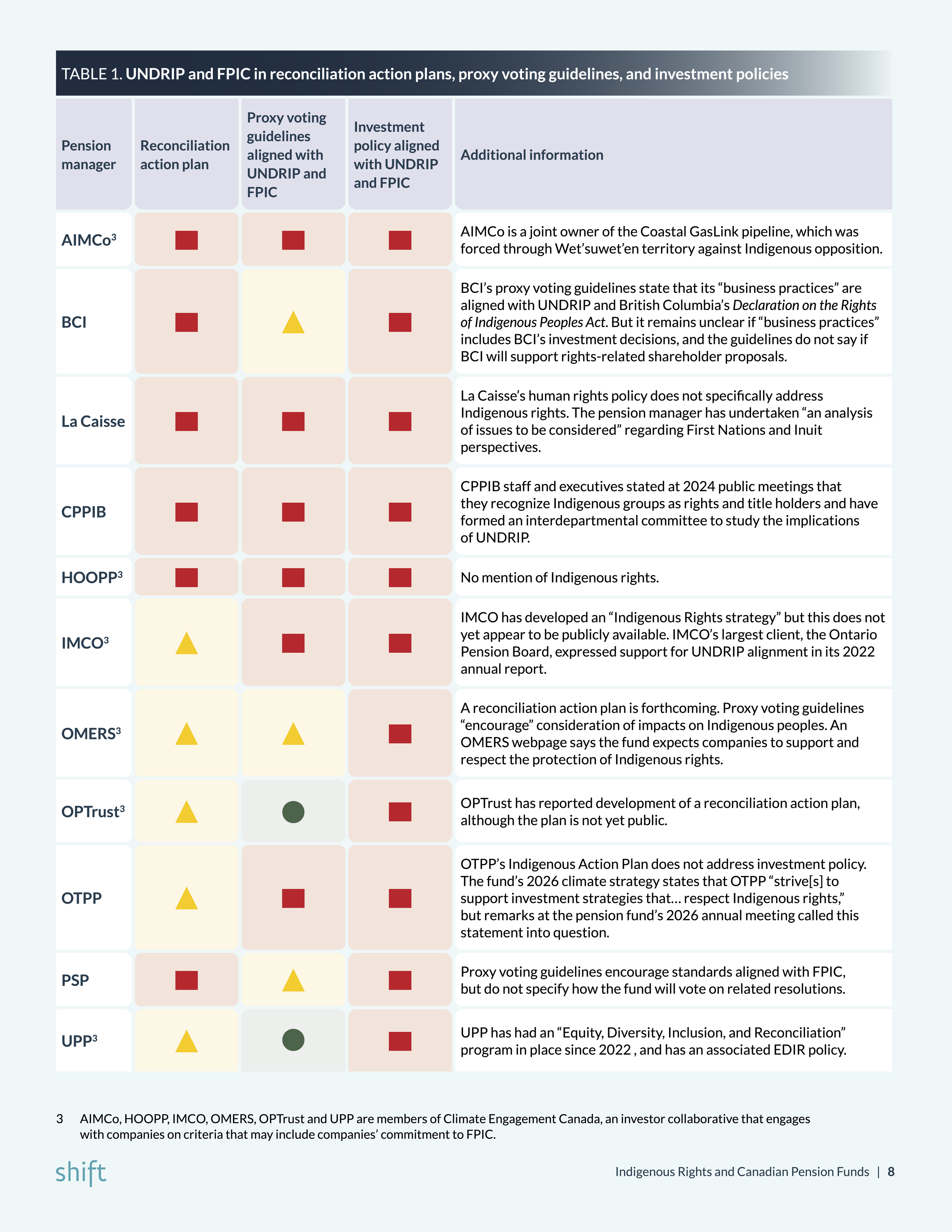
Shift: Action for Pension Wealth and Planet Health’s (Shift) August 2026 report, Indigenous Rights and Canadian Pension Funds, finds none of Canada’s large pension managers have publicly disclosed investment policies aligned with the United Nations Declaration on the Rights of Indigenous Peoples (UNDRIP) and its core principle of Free, Prior and Informed Consent (FPIC).
Such policies would provide required guardrails as pension funds navigate investment risks and opportunities, particularly as the federal government pressures them to invest in so-called “major projects” while it simultaneously undercuts the chances that such projects will meet the standard of FPIC.
Further, the report identifies at least four pension managers that have highlighted Indigenous economic benefits or opportunities related to investments in fossil fuel infrastructure, but have omitted mention of the climate-related financial risks and impacts that such investments create for pension beneficiaries and Indigenous communities.
Beginning steps - but much further to go
Of the 11 pension managers examined in the report, none, including the Canada Pension Plan Investment Board (CPPIB), have publicly disclosed investment policies citing UNDRIP or FPIC.
As least two pension managers - the Ontario Municipal Employees Retirement System (OMERS) and OPTrust - have reconciliation action plans under development at the time of the report’s release. Another pension manager mentioned the development of an “Indigenous rights strategy”, with no further details available, while another has released a plan that does not address investment decisions.
Investments in partnership with First Nations groups
The report revealed that at least four pension managers have partnered with First Nations groups on fossil fuel infrastructure investments - a concerning finding given that pension funds require a stable climate in order to generate long-term returns for their beneficiaries.
More positively, at least four pension managers have partnered with First Nations groups on climate solutions investments, including a transmission line, a net-zero real estate development, a solar project, and renewable energy infrastructure.
Economic participation and free, prior, and informed consent - two different things
Indigenous equity participation, while important from a reconciliation perspective, does not necessarily mean that rights issues have been addressed. Some fossil fuel “major projects”, such as the proposed LNG Canada Phase 2 and West Coast oil pipeline, may include elements of “economic reconciliation” but do not have FPIC from all impacted nations. For pension funds, such investments could create risks from both an Indigenous rights and a climate perspective.
Indigenous rights and a safe climate - both are critical
Investments that violate Indigenous rights and/or threaten climate stability can have a material impact on a pension manager’s ability to generate long-term returns. That’s why pension funds need to develop, implement and disclose Indigenous rights policies alongside credible climate plans.
Learn more and take action
Read the media release and download the report.
For interview requests, questions or comments, please contact info@shiftaction.ca.