Key climate takeaways from CPPIB’s Alberta public meetings
Last month, Canadians attending public meetings held by the Canada Pension Plan Investment Board (CPPIB) in Alberta pressed the managers of our $780-billion national pension fund on a growing contradiction: CPPIB executives acknowledge climate change is the biggest risk facing the Canada Pension Plan (CPP) – yet CPPIB continues to invest as if that wasn’t the case - betting billions on fossil fuel expansion.
On February 23rd and 25th, CPPIB held public meetings in Calgary and Edmonton. These meetings were rare opportunities for Canadians to speak directly with CPPIB staff and executives responsible for managing the retirement savings of over 22 million contributors and beneficiaries.
The Alberta meetings took place amid heightened scrutiny of CPPIB’s management of climate-related risks and a proposal by the Alberta government to pull the province out of the Canada Pension Plan (CPP) – putting the pension manager in a particularly sensitive position.
Recently, CPPIB has publicly spotlighted its investments in Alberta’s oil and gas industry, appeared on stage in downtown Calgary with oil and gas executives, and publicly pledged its support for oil and gas pipelines. CPPIB also faces a lawsuit from four young Canadians who claim that CPPIB is breaching its duty to invest in their best interests by failing to protect their pensions from climate risk while investing billions of dollars in oil, gas, coal and pipelines– which make the climate crisis even worse.
Against this backdrop, many attendees joined the public meetings to challenge CPPIB on its inadequate approach to climate risk and its ongoing investments in fossil fuel expansion. Based on attendees’ audio recordings of the Calgary and Edmonton sessions, here are some key climate takeaways from the meetings.
In the analysis below, Shift has provided the meeting location and timestamp of quotes made by CPPIB executives. Click these links to listen to full audio recordings of the CPPIB meetings in Calgary and Edmonton.
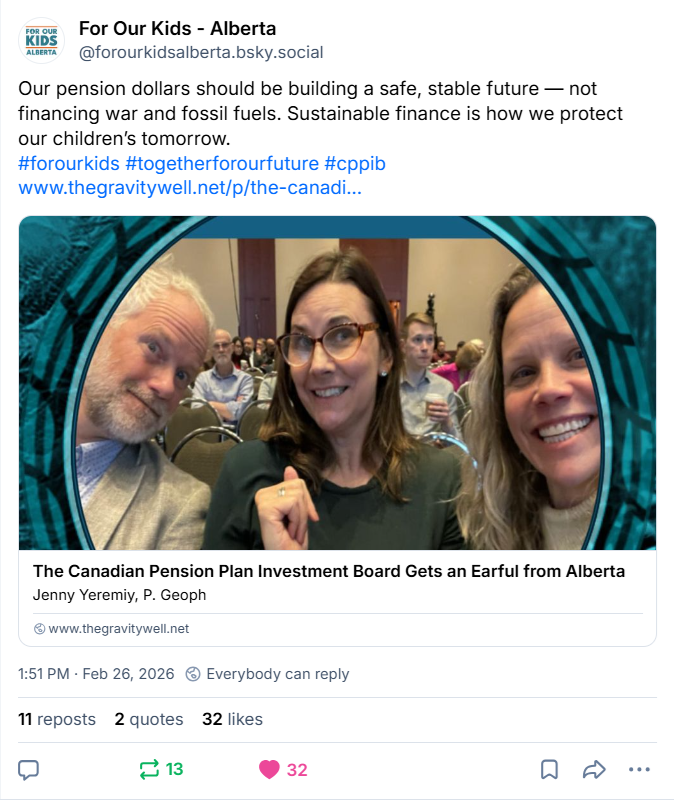
Screenshot of Bluesky post by supporters of For Our Kids - Alberta,
who attended CPPIB’s public meeting in Calgary on February 23rd.
Canadians made it clear to CPPIB that they’re concerned about the climate crisis
At both Alberta meetings, questions about climate change and CPPIB’s significant investments in fossil fuels dominated the Q&A sessions. In Calgary, five audience questions focused on CPPIB’s inadequate approach to managing climate risks, fossil fuel investments, and lack of policy on Indigenous rights. In Edmonton, five questions addressed the same issues.
In Calgary:
An emergency room physician challenged CPPIB on its abandonment of previous commitments to achieve net-zero by 2050 and invest $130 billion in “green and transition assets” by 2030 (at 20:04).
A geophysicist and educator challenged CPPIB on its view of carbon capture and storage technology, and reminded CPPIB that the oil and gas industry is not acting in good faith when it comes to decarbonization (at 32:30). (Read more about her experience at the Calgary meeting in her blog).
A mother of two teens questioned CPPIB’s 90% ownership of oil and gas producer Teine Energy (at 1:00:18), referencing footage showing unpermitted methane and other pollutants spewing from Teine’s infrastructure in Saskatchewan (at 24:00). A CPPIB executive responded that he’s “not in a position to speak for Teine. We are an investor in Teine, and we have a dialogue with them as investors in their operations” and that he was “more than happy to take your specific concerns and make sure that the people who work directly behind Teine can, you know, probe and scrutinize and have a better understanding of their operations.”
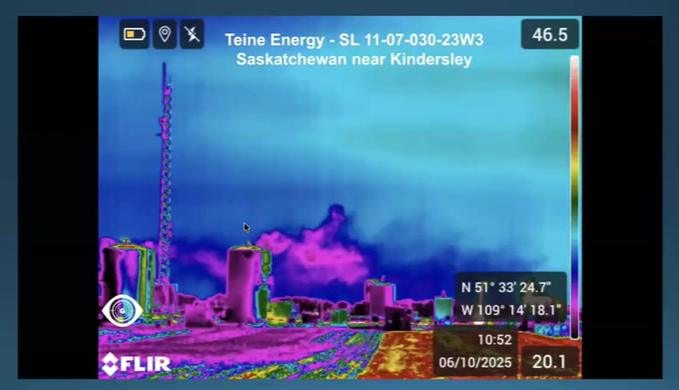
Optical Gas Imaging camera footage of a Teine Energy storage tank
releasing methane and other unpermitted pollutants into the atmosphere
(Source: Canadian Association of Physicians for the Environment. “Clean Air, Healthy Kids & Communities: The Case for Strong Methane Regulations,” at 24:00)
In Edmonton, a journalist reported on CPPIB’s risky investments in fossil fuels and the existence of fossil fuel interests on CPPIB’s board, and questioned CPPIB’s dubious claims that CPPIB is somehow advancing the energy transition by investing in oil and gas.
CPPIB acknowledged the urgency and severity of climate change
CPPIB’s Alberta meetings began with a glossy corporate video that emphasized the importance of climate risk to the fund’s long term performance. The video said that CPPIB “believe(s) companies that effectively manage sustainability-related factors, including climate risks, are better positioned for long term success” and that it’s “committed to adapting our approach and deepening our understanding of these risks” (Calgary, at 2:12).
During the meetings, Senior Managing Director & Chief Public Affairs Officer Michel Leduc went further than that in acknowledging the urgency and severity of climate change.
In Calgary, Leduc called climate change:
"the single biggest risk for a long-term horizon investor” (at 23:20); and
“absolutely the most significant challenge of our time” (at 57:00), noting physical risks and stranded asset risk in particular.
In Edmonton, he made similar remarks, describing climate change as:
“the single biggest source of risk for the fund” (at 29:00); and
“arguably the single biggest risk that we face as an investor,” referencing stranded assets, physical climate impacts, sudden shifts in energy demand, and concerns about the effects of climate change on long-term population health (at 44:00).
In Calgary, Leduc also mentioned that Canada’s Chief Actuary projects the CPP to be financially sustainable until at least 2099 (a forecast which does not take systemic climate risks into account), adding that “we care if the planet is not hospitable by that point” (at 57:00).
It is encouraging to see CPPIB executives acknowledging these climate risks, but this sense of urgency is not reflected in CPPIB’s investment strategy. In 2025, the pension manager abandoned its net-zero commitment and made at least $6 billion in new fossil fuel investments.
CPPIB offered no evidence to support its claim that fossil fuel investments are driving the energy transition
In some of the questions from Canadians, Leduc lamented questioners’ focus on fossil fuels (Edmonton, at 45:00), acknowledging that “there's a movement, you know, an expectation that we divest from fossil fuels” (Calgary, at 35:24).
He argued, without evidence, that continued investment in high-emitting companies can support decarbonization. Leduc said the transition to net-zero will not be linear and argued that responsible investors should stay invested in fossil fuel companies to help them decarbonize. He stated that “if the most responsible, sophisticated, engaged capital walks away, I think that that transition will be slower rather than faster” (Full exchange in Calgary starts at 32:30).
This is a bizarre statement to make for an investment manager that just minutes before promoted its investment in Teine Energy, Wolf Midstream and Canadian Natural Resources Ltd. (CNRL) (Calgary, at 14:11, Edmonton, at 10:07). After years of CPPIB ownership and investment, none of these fossil fuel companies have credible climate transition plans. For example, CNRL is Canada’s largest oil and gas producer, and is expanding production, lobbying against climate policies, and has no credible climate transition plan.
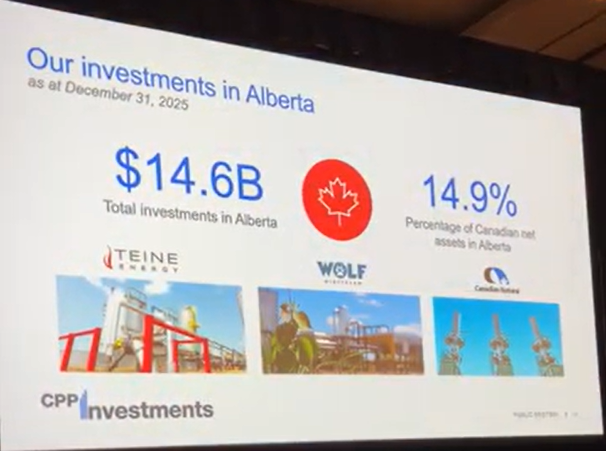
Picture of CPPIB’s presentation to attendees at its public meeting
in Calgary on February 23rd.
Leduc is correct that investors and asset owners can play a critical role in helping some large, high-carbon companies to decarbonize. But CPPIB provided no evidence that its own fossil fuel investments are accelerating that energy transition. Instead the fund owns or finances companies that are:
trying to construct or expand LNG terminals;
pushing to developnew gas plants instead of renewables; and
These investments suggest that CPPIB is in fact directly financing the expanded and prolonged use of fossil fuels, slowing the required rapid transition away from oil, gas and coal. CPPIB keeps pouring money from the CPP into fossil fuel companies that appear to have no intention of aligning their business model with a safe climate future.
A concerning lack of transparency from CPPIB
Although CPPIB says it holds itself to high standards of transparency and accountability (at 6:00), the structure of the public meetings limited public access. CPPIB did not livestream the meetings and did not publish transcripts or audio or video recordings afterward.
That means Canadians who couldn’t attend in person have no way to watch or listen to the discussions. Inside the room, many attendees felt that CPPIB staff did not meaningfully answer their questions. They reported that they felt the meetings were a public relations exercise that generated sanitized, rehearsed answers that didn’t actually address their climate concerns and didn’t allow for meaningful engagement or legitimate disagreement.
Canadians’ transparency concerns extend beyond the in-person meetings themselves. In 2024, over 8,000 Canadians submitted questions online to CPPIB’s public meetings process. CPPIB failed to respond to those questions.
For public meetings held by a Crown corporation that manages the public pension fund for 22 million Canadians, this lack of transparency raises serious accountability concerns. Ironically, the only recordings available from the Alberta meetings exist because attendees used their phones to record the discussions themselves.
CPPIB says it is independent from politics – but its investments actively shape political outcomes
CPPIB emphasized in its opening remarks that it operates independently from governments, and does “not pursue other public policy objectives or political priorities” in its investment strategy (Calgary, at 5:50)
But CPPIB also acknowledged that the world’s ability to transition to net-zero is dependent on government policy and regulation, which Leduc called a very forceful lever (Calgary, at 24:45) in driving the “whole economy transition” needed to avert catastrophic climate change. In Shift’s opinion, it could become impossible for CPPIB to fulfill its mandate without urgent action to phase out fossil fuels and limit global heating to safe levels.
As one audience member who identified herself as a political scientist pointed out at the Edmonton meeting (at 58:58), investment decisions that shape the economy are inherently political – even if investors claim neutrality.
Meanwhile, CPPIB’s portfolio companies are clearly active in shaping politics. In 2026 alone:
The CEO of CPPIB-backed VoltaGriddonated US$250,000 to a superPAC for an oil and gas lobbyist running in a Republican Senate primary and endorsed by President Trump;
CPPIP-owned Tallgrass Energyattended a meeting at the White House to discuss how the Trump Administration could work with American oil and gas companies to exploit Venezuelan oil;
The CEO of CPPIB-owned BNI Coal and BNI Energy announced his campaign to run for the Republican nomination in North Dakota’s 33rd District, outlining his priority to “develop North Dakota’s energy resources”.
While CPPIB may not see itself as a political actor, its investments influence energy policy, infrastructure decisions and the pace of the global energy transition.
Leduc also said that CPPIB “follow(s) the progress of the global transition, say with the Paris Agreement as the benchmark, and we probably agree with you that the pace following the Paris Agreement of progress is frustrating” (Edmonton, at 44:36).
Leduc is correct. The energy transition is moving too slowly, and the impacts of climate change are being felt earlier and more severely. So why does CPPIB sit on the sidelines while some governments dismantle climate policies and some of its own investments and portfolio companies make the climate crisis even worse by expanding and prolonging the use of fossil fuels?
Join our movement of Canadians calling on CPPIB to stop investing in fossil fuel expansion and develop a credible climate strategy
Public meetings with CPPIB are rare opportunities for Canadians to question how their retirement savings are being invested. In Alberta last month, many attendees used that opportunity to express deep concern about climate change and CPPIB’s ongoing use of our collective retirement savings to invest in the oil, gas, coal and pipelines that are fueling the climate crisis.
Many left the meetings feeling that their questions and concerns had not been meaningfully addressed – and that CPPIB’s investment strategy still does not match the urgency of the climate risks that its own executives acknowledge.
There is no retirement security without a safe climate future to retire into. Climate risks are every bit as significant as CPPIB executives say they are. Canadians deserve to see that urgency reflected credibly in how their national pension fund is invested.
CPPIB’s mandate could become impossible to fulfill if we fail to avert the worst outcomes of climate change. We need more Canadians to make sure our pension managers understand this. Join our growing movement demanding climate action from CPPIB!