
CPPIB’s climate disclosure shows a snapshot without a strategy
The Canada Pension Plan Investment Board (CPP Investments, or CPPIB) announced an additional climate disclosure earlier this month, entitled “Analyzing CPP Investments’ global portfolio carbon footprint: Notes on New Climate Disclosure Framework.”
This is a small but welcome improvement in transparency that appears to be a response to the climate litigation launched against CPPIB in October 2025. But for Canadians concerned about the sustainability of the Canada Pension Plan amidst a worsening climate crisis, the new disclosure provides little indication that CPPIB is treating climate change with the urgency or gravity that is required. From what is disclosed, CPPIB does not appear to have a plan to protect its portfolio from significant climate-related financial risks, or to ensure Canadians’ retirement security in a climate safe future.
The purpose of CPPIB’s new climate disclosure remains unclear, as our national pension manager concedes that its carbon footprint analysis “does not alter CPP Investments’ investment strategy, underwriting approach, stewardship framework, or portfolio construction flexibility.” The climate disclosure acknowledges that CPPIB’s portfolio is largely unaligned with a safe climate future, yet states that the pension manager will make no meaningful changes to its investment strategy as a result. For Canadians already facing the impacts of climate change today, CPPIB’s approach remains troubling.
The seven-page document provides a snapshot of CPPIB’s portfolio carbon footprint as of March 31, 2026. It classifies individual holdings across two characteristics: carbon intensity and transition governance. Shift is encouraged to see a 52% decline in CPPIB’s portfolio carbon footprint since fiscal year 2020 (a measure of emissions intensity, not absolute emissions reductions), and a growing number of portfolio companies undergoing an assessment under CPPIB’s internal “Decarbonization Investment Approach.” Shift is also encouraged that CPPIB has committed to disclose these new climate metrics on an annual basis.
But CPPIB also disclosed that $516.1 billion of its assets (or 65.5% of the CPP fund) demonstrate no evidence of “transition governance” – that a company or asset has taken steps to understand and prepare for climate-related transition risks and opportunities. Of particular concern, CPPIB considers $65.6 billion of its holdings to be high-carbon assets “from harder to abate industries” that have “no observable evidence” of transition governance.
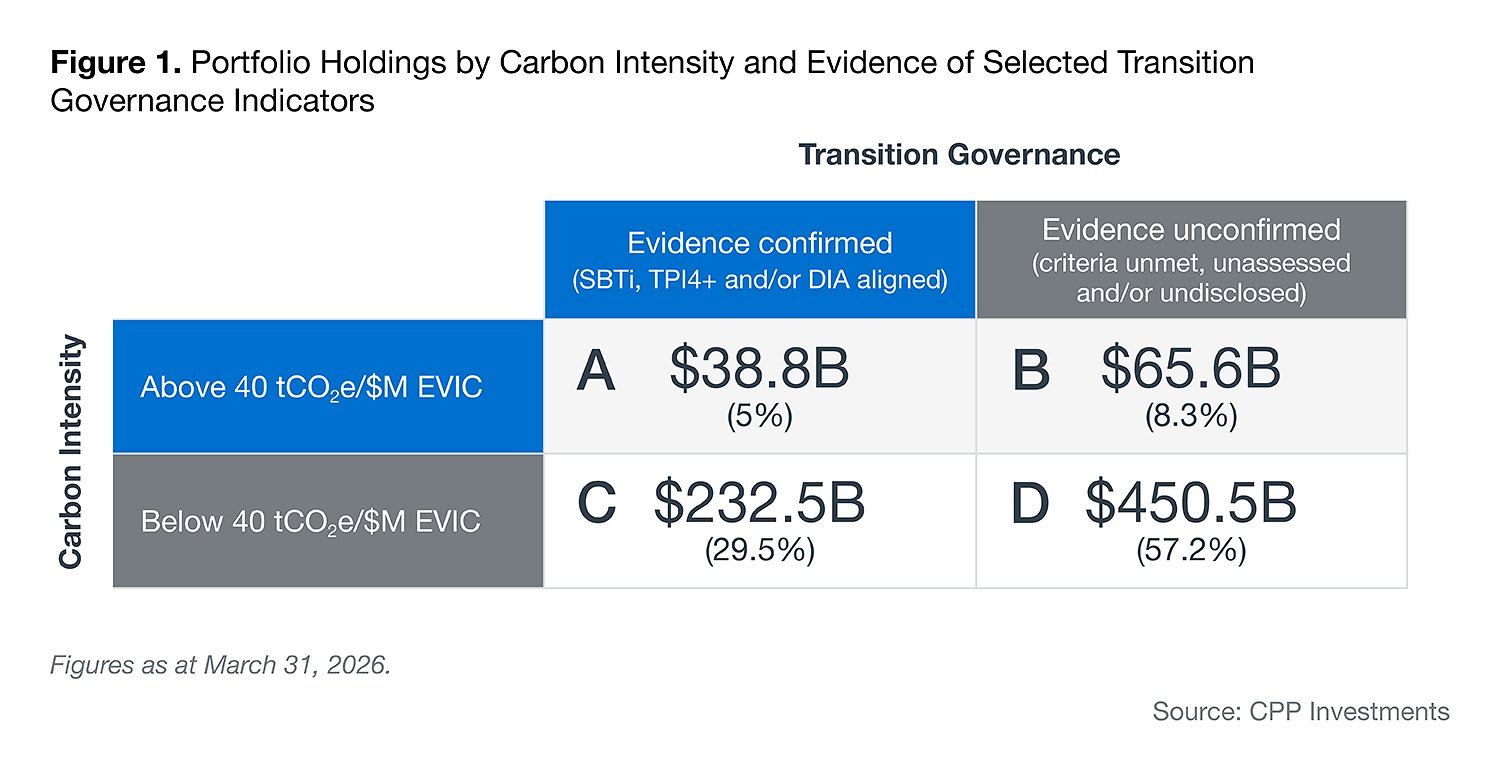
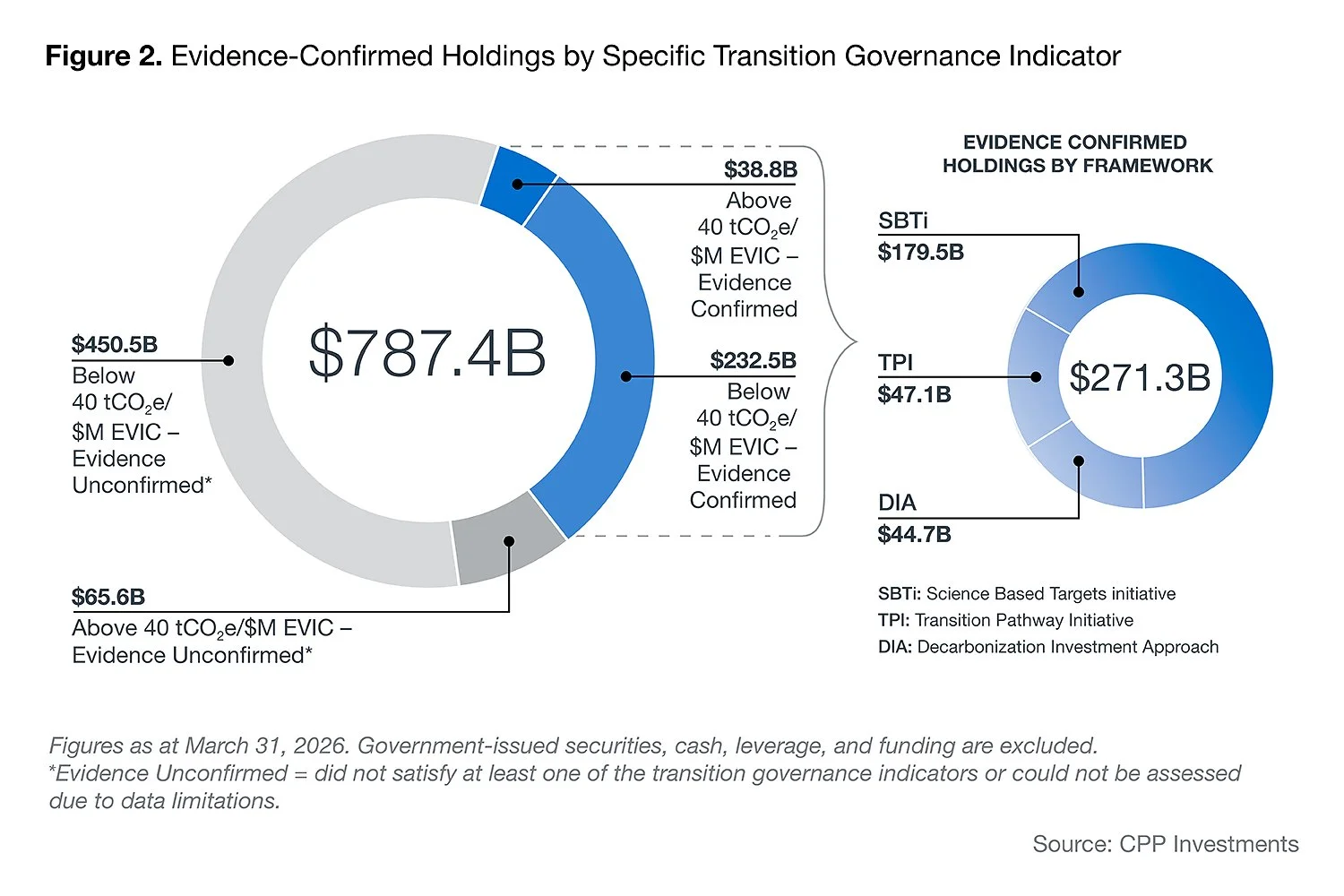
Source: CPP Investments. (August 14, 2026). “CPP Investments launches expanded portfolio carbon footprint reporting.”
Canadians have reason to question CPPIB’s claim that the fund is sustainable for 75 years, when nearly two-thirds of its holdings fail to demonstrate readiness for a future of climate disruption and energy transition. CPPIB has no disclosed climate action plan, no net-zero emissions commitment, no targets to reduce portfolio emissions, no goals to invest more in profitable climate solutions, and no exclusions on financing the primary drivers of climate change – oil, gas and coal. In 2025 alone, CPPIB made at least $6 billion in risky new bets on fossil fuel assets that will prolong the use of oil and gas and make the climate crisis worse.
Canadians are facing the impacts of climate change right now, and it’s difficult for young Canadians in particular to understand how CPPIB can claim to protect their retirement security when it has no publicly disclosed strategy to navigate the climate crisis. CPPIB is facing a lawsuit brought by young Canadians, who allege our national pension manager is failing to adequately manage climate risks while investing billions in the expansion of fossil fuels.
Join them in demanding action to stop fueling the climate crisis with our pensions and protect our financial future.
