
Our pension. Our questions.
The Canada Pension Plan Investment Board (CPPIB) manages the retirement savings of over 22 million Canadians. At $864 billion, the Canada Pension Plan (CPP) is one of the largest pension funds in the world. But rather than using that financial power to lead the transition away from fossil fuels that scientists agree is essential, CPPIB continues to invest billions in fossil fuel expansion.
The assets CPPIB manages on behalf of CPP members are our retirement savings. The investment board owes contributors and beneficiaries a duty to maximize returns over the long-term without undue risk of loss. That makes its investment decisions a matter of public interest – particularly as CPPIB faces pressure to finance major “nation-building” projects and make strategic investments in Canada.
CPPIB's continued investment in fossil fuel expansion raises fundamental questions about the climate crisis, long-term financial risk, and the retirement security of Canadians on a livable planet. Canadians have a right to know how CPPIB is assessing those risks – and whether its investment strategy is consistent with its duty to CPP members.
Public meetings
This year’s meetings come at an important moment. Since the last public meetings in 2024, CPPIB has abandoned its commitment to reach net-zero emissions by 2050, is facing a legal challenge over its inadequate management of climate-related financial risk, and has added a director who also serves on the board of Canadian Natural Resources Limited, one of Canada's largest oil and gas producers. As more and more Canadians experience the worsening impacts of climate change – deadly fossil-fuelled wildfires, heatwaves, droughts, storms and floods – CPPIB and its portfolio companies continue to invest billions of dollars in oil and gas expansion. Now, CPPIB is taking on a prominent role in attracting and deploying capital into major Canadian infrastructure and strategic projects.
That makes these public meetings a critical opportunity for Canadians to ask CPPIB leadership directly how it is managing climate risks and making investment decisions on our behalf.
This fall, Canadians have a rare opportunity to ask those questions directly to CPPIB leadership. CPPIB is required to hold public meetings across Canada every two years, making the upcoming 2026 meetings one of the few opportunities for CPP members to engage directly with the organization responsible for managing their retirement savings.

It also means that the questions Canadians can ask at these meetings are more important than ever: How is CPPIB assessing climate-related financial risks? What safeguards are in place when three of CPPIB’s directors have ties to fossil fuel companies? How will CPPIB ensure that investments respect Indigenous rights? How can CPPIB justify its investments in fossil fuel expansion projects in the midst of the climate crisis in light of its duty to protect the long-term interests of CPP members?
CPPIB is responsible for investing Canadians' retirement savings for the long term. Canadians should be able to expect a credible plan for managing climate risks, respecting Indigenous rights, and making investment and asset management decisions that protect the long-term interests of contributors and beneficiaries.
Sign the petition and join thousands of Canadians calling on CPPIB to:
1. Present a credible climate plan showing how the Canada Pension Plan will reduce emissions across its investments and protect our retirement future.
2. Stop investing in fossil fuel expansion that puts Canadians’ retirement security at risk.
3. Respect Indigenous rights by ensuring investments uphold free, prior and informed consent.
Add your voice: call for responsible management of our retirement savings
Turn up and be heard
This is a rare opportunity for Canadians to sit face to face with CPPIB executives and ask them how they are managing climate risk, respecting Indigenous rights and protecting the long-term interests of CPP members.
Find a meeting near you, register to attend and make your voice heard.
Ask the tough questions
What should Canadians be asking CPPIB leadership? Here are some sample questions:
CPPIB executives regularly and consistently make public comments expressing their continued support for the oil and gas industry. This year, the impacts of climate change disrupted the lives of over 60% of Canadians, with hundreds dying from extreme heat and wildfires, thousands evacuating their communities due to wildfires, and millions impacted by toxic wildfire smoke. How is it in the best interest of Canadians to continue investing in the primary cause of these climate impacts – fossil fuels? Don’t the worsening impacts of climate change and the accelerating energy transition require a change in CPPIB’s investment strategy?
CPPIB said in 2022 that it “believe(s) stewarding the portfolio to net zero is in the best interests of contributors and beneficiaries of the Canada Pension Plan, and in line with our mandate of maximizing returns without undue risk of loss.“ So why did CPPIB abandon its net-zero by 2050 commitment just three years later? Why is net zero in 2050 no longer in the best interests of Canadians?
As a Crown corporation, why doesn’t CPPIB have a policy to align its investments with the United Nations Declaration on the Rights of Indigenous Peoples, including the right to free, prior and informed consent for projects and companies that impact Indigenous groups?
We've created a briefing with questions you can take into the room and ask directly.
What’s changed at CPPIB since the 2024 public meetings?
CPPIB abandoned its climate commitment
CPPIB committed to achieve net-zero emissions by 2050 in February 2022, saying at the time that “we believe stewarding the portfolio to net zero is in the best interests of the contributors and beneficiaries of the Canada Pension Plan and meeting our mandate.”
But in spring 2025, CPPIB abandoned its commitment to net-zero by 2050, an unacceptable abdication of its responsibility to manage our national pension fund without undue risk of loss. This raises critical questions about how CPPIB’s new approach reflects its responsibility to manage our national pension fund in the best long-term interests of contributors and beneficiaries in light of mounting climate risks.
CPPIB now has no disclosed climate action plan, no net-zero emissions commitment, no targets to reduce portfolio emissions, no goals to invest more in profitable climate solutions, and no exclusions on financing the primary drivers of climate change – oil, gas and coal. In 2025 alone, CPPIB made at least $7 billion in new fossil fuel investments .
Climate risk litigation
CPPIB is facing climate risk litigation by young Canadians who allege that our national pension manager is breaching its duty to invest in their best interests by failing to protect their pensions from climate risk while investing in fossil fuel expansion. The case will go before the Ontario Superior Court in November 2026.
Meet Aliya, one of the young Canadians challenging CPPIB in court to protect our retirement security.
Climate-related conflict of interest concerns
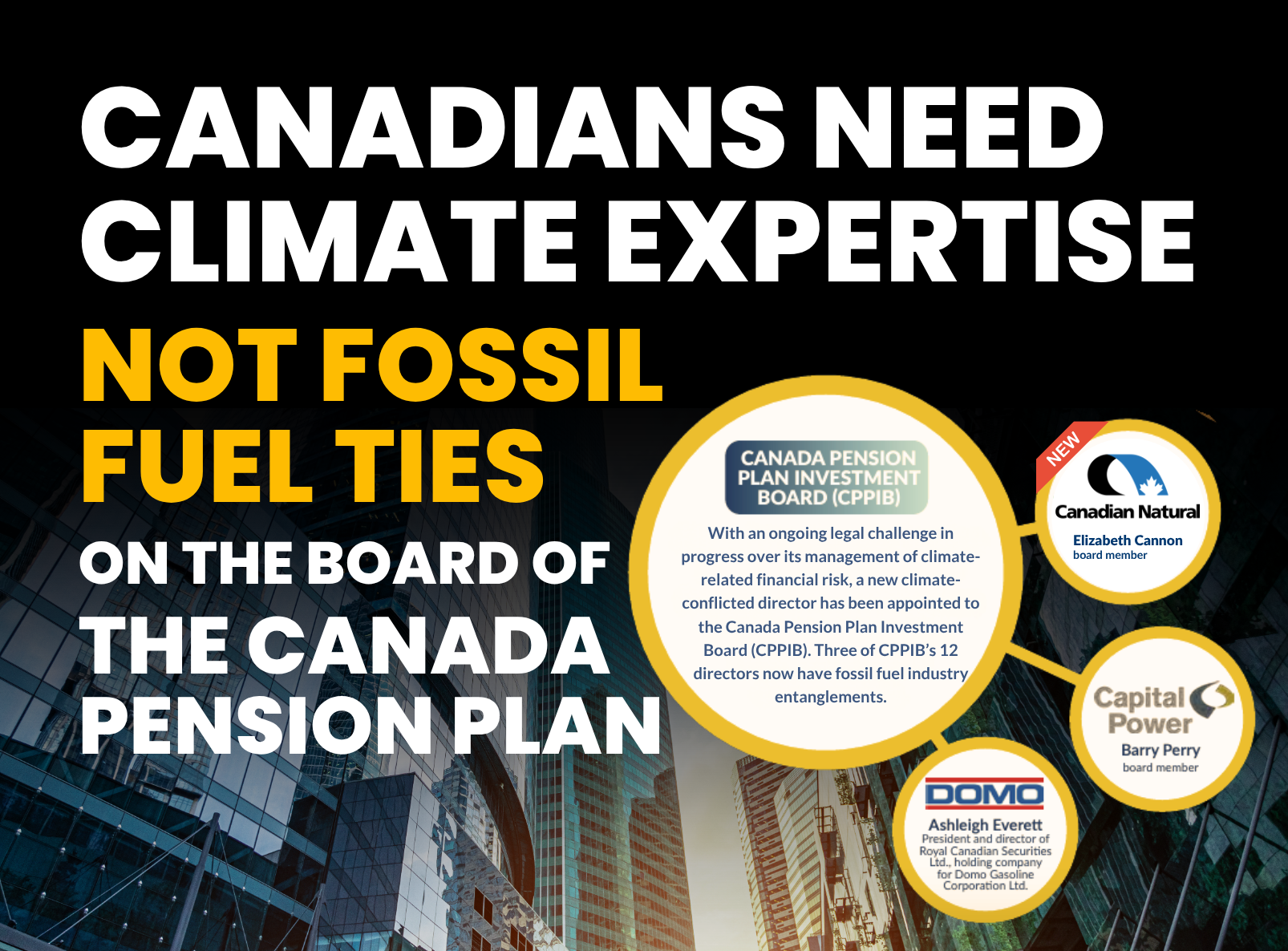
CPPIB’s board of directors also has a conflict of interest problem when it comes to managing climate risks: three of the current twelve-person Board of Directors are executives or corporate directors of fossil fuel companies.
Shift’s June 2025 report Entrenched Interests: Fossil Fuel Ties On Canada’s Pension Boards examined those members of CPPIB’s board that held fossil fuel roles when CPPIB abandoned its net-zero by 2050 commitment in May 2025, raising serious concerns about the potential for conflicts of interest.
In 2026, a director from Canadian Natural Resources Limited (CNRL), one of Canada's largest oil and gas producers, was appointed to the CPPIB board, meaning that one-quarter of the board currently has fossil-fuel ties.
These appointments raise questions about how CPPIB identifies and manages potential conflicts when directors also have responsibilities to companies whose financial interests are tied to fossil fuel production.
No Indigenous rights investment policy
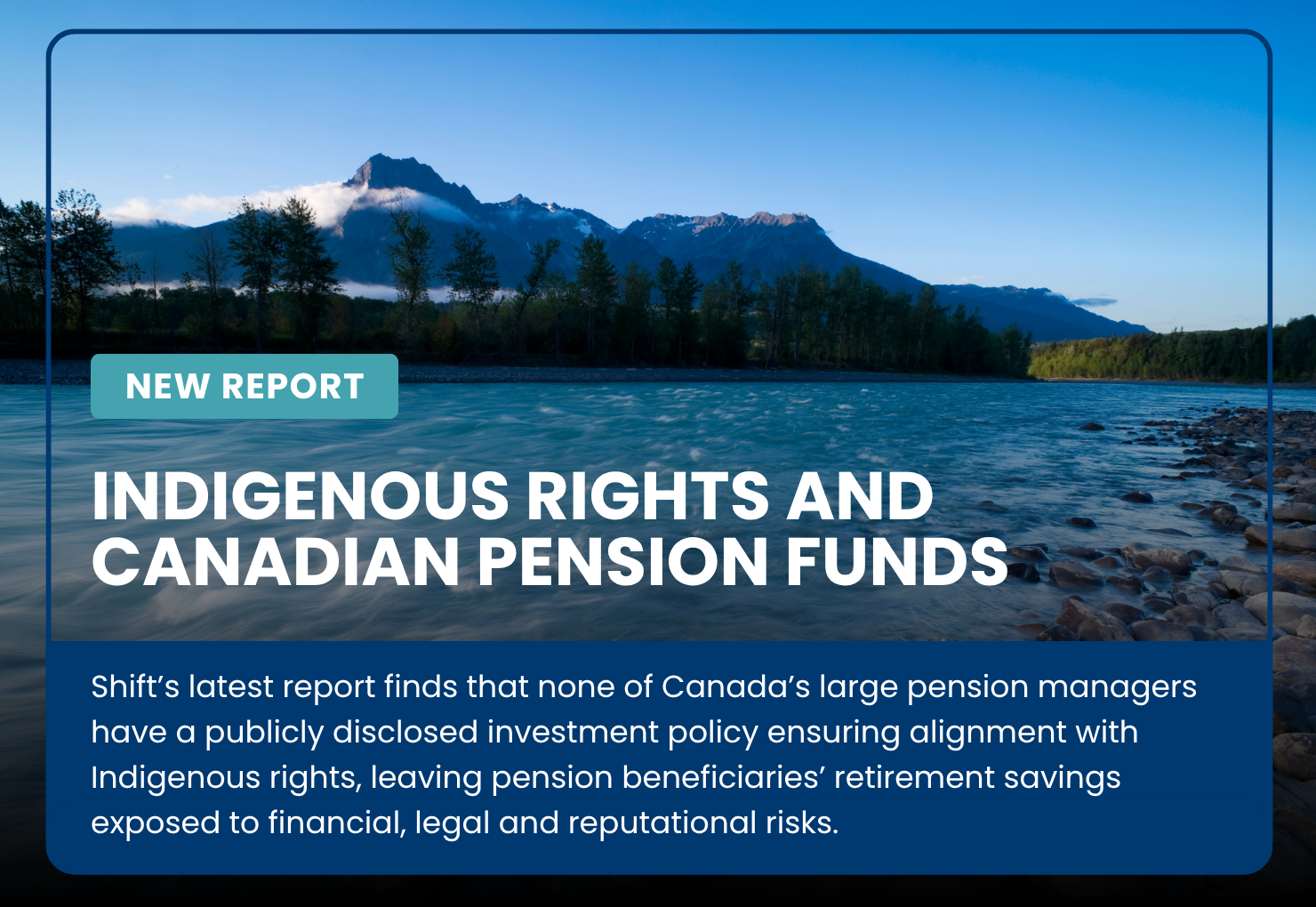
After another summer of extreme heat, flooding, and wildfires around the globe, we’ve seen that Indigenous communities often bear the brunt of the climate crisis. One example is the members of the Okanagan Indian Band, who lost homes and artifacts during the Bradley Creek wildfire and saw their land turned to ash. Shift’s August 2026 report, Indigenous Rights and Canadian Pension Funds, found that CPPIB does not have a public investment policy aligned with Indigenous rights, despite being a Crown corporation.
The question is particularly important as CPPIB considers investments in major so-called “nation-building” projects that may affect Indigenous rights, lands and communities.
“Respecting First Nations title and rights by embedding free, prior and informed consent into investment decisions is fundamental to responsible investment. We call on the Canada Pension Plan Investment Board, which impacts all Canadians, and other investors to demonstrate that free, prior and informed consent is fully integrated into their investment decisions and strategy.”
– Grand Chief Stewart Phillip, President of the Union of British Columbia Indian Chiefs
A bigger role in Canada’s investment agenda
In September 2026, CPPIB partnered with the federal government to co-host the Canada Investment Summit. CPPIB touted “the further development of conventional and renewable energy and strategic infrastructure.” CPPIB and Brookfield also announced a $50-billion investment fund focused on “critical infrastructure and strategic industries across Canada.” The new role gives CPPIB an even more prominent place in decisions about where long-term Canadian capital is invested. That makes questions about CPPIB's investment strategy – including its approach to climate risk and Indigenous rights – increasingly important.
Help spread the word
This fall’s public meetings are one of the few opportunities Canadians have to question CPPIB leadership directly. Help make sure those questions are heard. Share the public meeting information with your friends, family and networks, and encourage them to attend.
For more information on CPPIB’s approach to climate risk and investments in fossil fuels, see Shift’s detailed climate analysis of CPPIB.
We also produce a quarterly report on CPPIB’s fossil fuel investments – you can read the latest edition of CPPIB Watch here.