
The federal government is pressuring your pension fund to invest in LNG and pipelines
Your pension fund is facing pressure from the federal government to finance so-called major projects “in the national interest”. Several of these projects include risky new fossil fuel infrastructure like liquefied natural gas (LNG) terminals and pipelines, which carry unacceptable financial risks, climate and environmental consequences, and lack consent from impacted First Nations and Indigenous communities.
Finance Minister François-Philippe Champagne is meeting quarterly with pension funds and other institutional investors to encourage participation in these projects. Some funds have already expressed interest: last fall, the president and chief executive officer of the Canada Pension Plan Investment Board (CPPIB) told a Bay Street luncheon that CPPIB is “looking to invest in nation-building projects: large scale infrastructure and energy systems” before going on to tell the Financial Post that “here in Canada, we like pipelines, we like oil and gas pipelines.” The same month, CPPIB’s senior managing director and global head of real assets falsely claimed that “LNG infrastructure is central to meeting rising global demand and supporting long-term transition goals.” In March, the chief investment officer of the Healthcare of Ontario Pension Plan (HOOPP) declared the fund’s readiness to invest in Canadian infrastructure, with Reuters reporting that “some of those investments could be in Canadian pipelines, if they were somehow in line with the fund's 2030 climate goals.” These are major red flags, as no credible climate strategy could include investment in new pipelines or LNG infrastructure.
Your retirement security is on the line. There is a narrow window to ensure pension funds protect your retirement savings from risky bets on fossil fuels.

What’s at stake
The federal government has established a Major Projects Office, a special operating agency to fast-track so-called “nation-building” projects. Many of these projects carry significant financial, legal and climate risks. They face financing challenges, cost overruns, uncertain long-term demand, growing legal challenges, and opposition from Indigenous communities. Yet pension funds are facing pressure to invest anyway – putting retirement savings at risk in a rapidly shifting energy system.
Backtracking on climate, environmental protection and Indigenous rights.
The trade war instigated by United States President Donald Trump prompted an “elbows up” agenda from the Canadian government, including plans to aggressively advance fossil fuel expansion at the expense of climate obligations and Indigenous rights.
In May 2025, Prime Minister Carney appointed Tim Hodgson as Minister of Energy and Natural Resources, drawing on Hodgson’s connections and experience in financing major fossil fuel infrastructure projects as a bank executive, pension fund director and board member with oil sands producer MEG Energy.
In June 2025, the federal government passed Bill C-5, which allows projects deemed “in the national interest” to bypass federal laws, including environmental impact assessments. Bill C-5 faces significant opposition from citizens supporting democracy, climate action and Indigenous rights – including a court challenge from several First Nations.
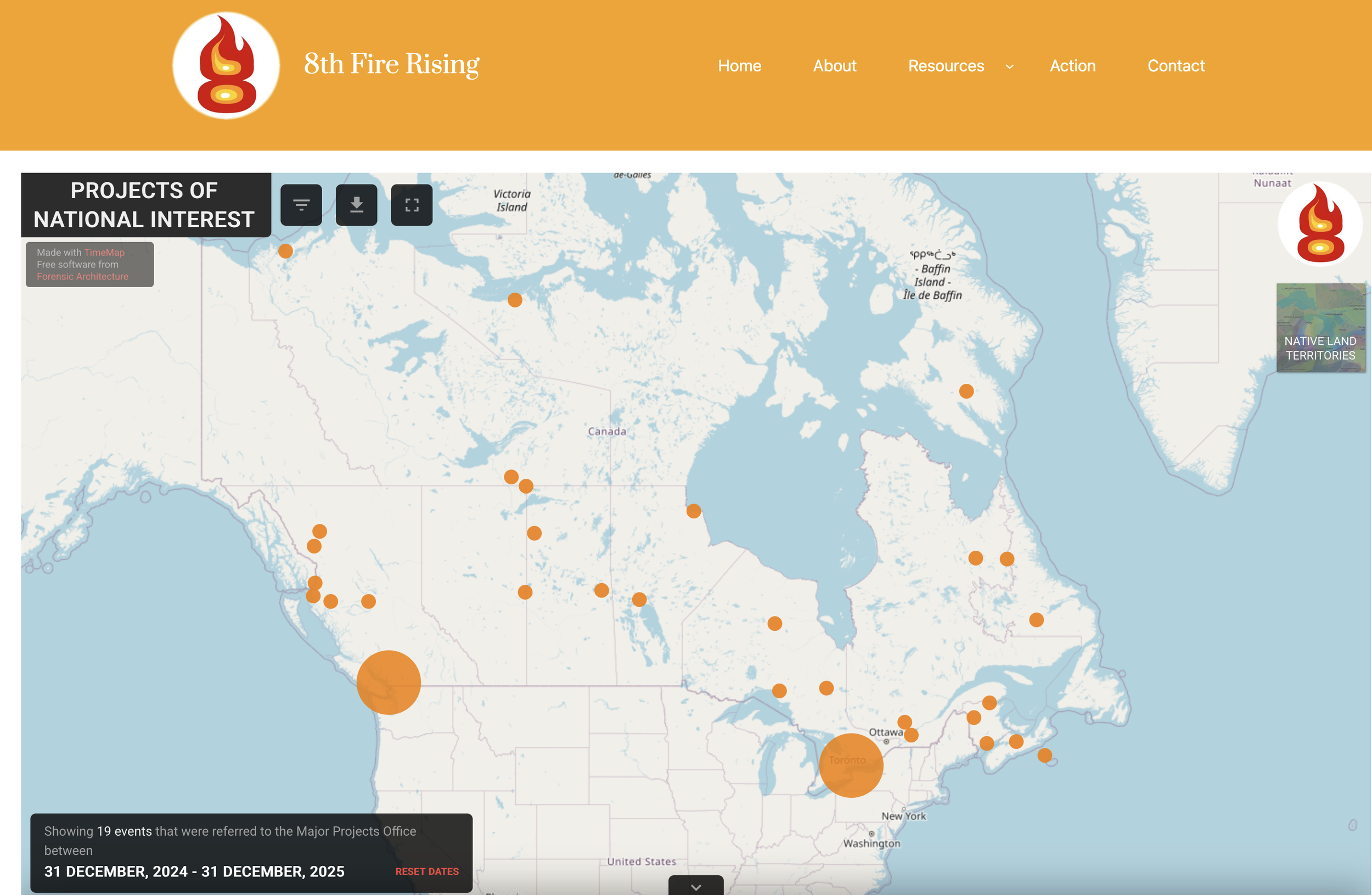
Map of projects of national interest referred to the Major Projects Office as of April 1, 2026, mapped by 8th Fire Rising, an Indigenous-led coalition of concerned and impacted communities.
In August 2025, Prime Minister Carney set up the Major Projects Office (MPO), headquartered in Calgary, and announced the appointment of former pipeline executive Dawn Farrell as CEO. In September and November, the prime minister announced the first sets of projects being referred to the MPO for consideration for fast-tracking, including new LNG terminals.
Later in November, the federal and Alberta governments announced a highly contentious Memorandum of Understanding announcing federal support for a new oil sands pipeline and carbon capture, utilization and storage (CCUS) project, along with a major rollback of federal climate policies, including ending the West Coast tanker ban, scrapping the proposed oil and gas emissions cap, suspending clean electricity regulations in Alberta, slating new transmission infrastructure to support fossil fuel expansion instead of electrification, and delaying key climate rules such as methane reductions.
In the span of less than one year since taking office, the federal government has significantly weakened Canada’s climate policy framework and attempted to fast-track fossil fuel projects that could lock-in the increased use of oil and gas for decades to come.
Proposed LNG projects in BC: financial, legal, and environmental risks
With this political context, it should not be surprising that many of the major projects deemed “in the national interest” carry significant financial risks. Here are some of the LNG and pipeline projects that your pension could be asked to invest in:
-
LNG Canada Phase 2 in Kitimat, BC, would significantly expand Canada’s first LNG export terminal, which started shipping in June 2025. The export terminal receives its fracked gas supply via the controversial Coastal GasLink pipeline, which was forced through Wet’suwet’en lands and waters without the permission of Hereditary Chiefs.
Since start-up in September 2024, an “integrity issue” with an LNG Canada flare stack has led to flaring 15 times over expected levels, raising serious environmental and health concerns for local residents.
LNG Canada Phase 2, which would double production, was referred to the MPO for fast-tracking in September 2025, raising concerns over both Indigenous rights and climate.
-
Ksi Lisims LNG, planned for Pearse Island, BC near the Alaska border, is a proposed export terminal with an associated pipeline to supply gas for liquefaction and export.
BC’s environment and energy ministers approved the Ksi Lisims project in September 2025, and the project was referred to the MPO in November. If constructed, Ksi Lisims would become Canada’s second largest LNG facility. While proponents highlight future electrification, the facility is expected to be powered by gas for years before electricity transmission infrastructure is in place. Despite the Nisg̱a’a Nation being one of the proponents, the project faces strong opposition and legal challenges from some First Nations groups.
-
The Prince Rupert Gas Transmission (PRGT) project is an 800-kilometre pipeline intended to carry fracked gas from northeast BC to the proposed Ksi Lisims LNG facility, crossing more than 1,000 waterways, including major salmon-bearing rivers and tributaries.
In June 2025, the BC government approved the project after the Environmental Assessment Office determined it had been “substantially started.”
Despite having the support of the Nisg̱a’a Nation, the project has faced significant opposition from Indigenous communities, including leaders in the nearby Gitanyow and Gitxsan territories, who are concerned about threats to their lands, waters and wildlife. The pipeline and associated Ksi Lisims LNG project are now the subject of multiple lawsuits – including from members of the Nisga’a Nation itself.
-
The North Coast Transmission Line (NCTL) is a proposed 95-kilometre electrical transmission line largely intended to supply electricity to the Ksi Lisims LNG facility.
Questions remain about whether BC can supply sufficient electricity to power LNG expansion, particularly given that key transmission infrastructure may not be completed until at least 2032, raising doubts about whether electrification claims are realistic in the near term. Cost estimates of the NCTL have already doubled, despite the project receiving significant federal subsidies.
-
Cedar LNG, located in Kitimat, BC, a few kilometres from LNG Canada, is a proposed floating LNG processing facility and marine export terminal. The project is a partnership between the Haisla Nation and Pembina Pipeline Corporation and would be supplied by the Coastal GasLink pipeline.
The BC government approved the project in March 2023. In 2025, the federal and provincial governments committed up to $400 million in public funding, including subsidies to electrify the facility. While electrification may reduce some operational emissions, it has little impact on the significant lifecycle emissions of LNG, and public funding for the project may expose governments to potential litigation risks following the International Court of Justice’s 2025 Advisory Opinion on states’ obligations to address climate change.
Financial risk: a high-stakes bet on a shrinking market
Canadian LNG facilities have a history of cost overruns and delays: Woodfibre LNG has already exceeded its budget by 72.5% and counting, while Coastal GasLink – the feeder pipeline for LNG Canada – ran 133% over budget. LNG Canada’s backers, including Petronas, Shell and Mitsubishi, have either already reduced their exposure or are looking to do so.
Globally, the sector faces structural oversupply, with dozens of LNG projects competing to supply the same markets. With gas demand expected to flatten or decline as the world rapidly electrifies and builds clean energy, new LNG projects are likely to face lower prices once they come online – making it difficult for financiers to recoup their investment. Recent market signals point in the same direction: in December 2025, Energy Transfer cancelled its Lake Charles LNG project in Louisiana due to a lack of investors, and Shell pulled out of a major Argentinian LNG export project – indications that investors are cautious about committing to new LNG infrastructure. There are signs that even existing shipment contracts have also been scaled back as the energy transition continues to go faster than anticipated. For example, Pakistan cancelled 35 LNG cargoes from Qatar last year, highlighting the volatility and uncertainty of the long-term global market.
This growing mismatch between new supply and declining demand creates a clear risk: many proposed LNG projects could become stranded assets, built at high cost but no longer economically viable in a decarbonizing energy system powered by cheap renewables. Analysts expect global fossil fuel demand, including for gas, to peak this decade, reinforcing the risk that LNG infrastructure will outlast its market.
Recent short-term energy shocks reinforce, rather than undermine, this trend. Russia’s invasion of Ukraine temporarily pushed prices higher, but it also accelerated the energy transition, prompting Europe and other regions to diversify away from gas faster and invest more heavily in domestic clean energy. The escalating war in the Middle East has triggered similar price spikes, underscoring how deeply fossil fuel markets are vulnerable to geopolitical instability. Building new decades-long LNG projects to chase these short-term dynamics exposes investors to sustained volatility, not stable returns. The real solution to energy security is accelerating the transition away from fossil fuels.
Meanwhile, the broader energy transition is reshaping global markets. In 2025, global investment in renewable energy, electricity grids, storage and other low‑carbon technologies was twice the amount invested in oil, gas and coal. Major economies are accelerating this shift: Europe’s March 2026 commitment to cut greenhouse gas emissions by 90% by 2040 signals a rapid move toward electrification and clean energy systems. As a result, new LNG infrastructure will increasingly compete directly with cheaper, quicker-to-deploy renewables – further eroding its long term value.
Beyond market dynamics, LNG projects face significant legal and regulatory uncertainty, with many BC proposals having been delayed or blocked by court action – obstacles that governments cannot remove. Combined, these financial, market, and regulatory pressures mean that new LNG projects are likely to underperform or become stranded assets, creating significant risk for pension funds and long-term investors.
Climate impacts: high emissions, long-term lock-in
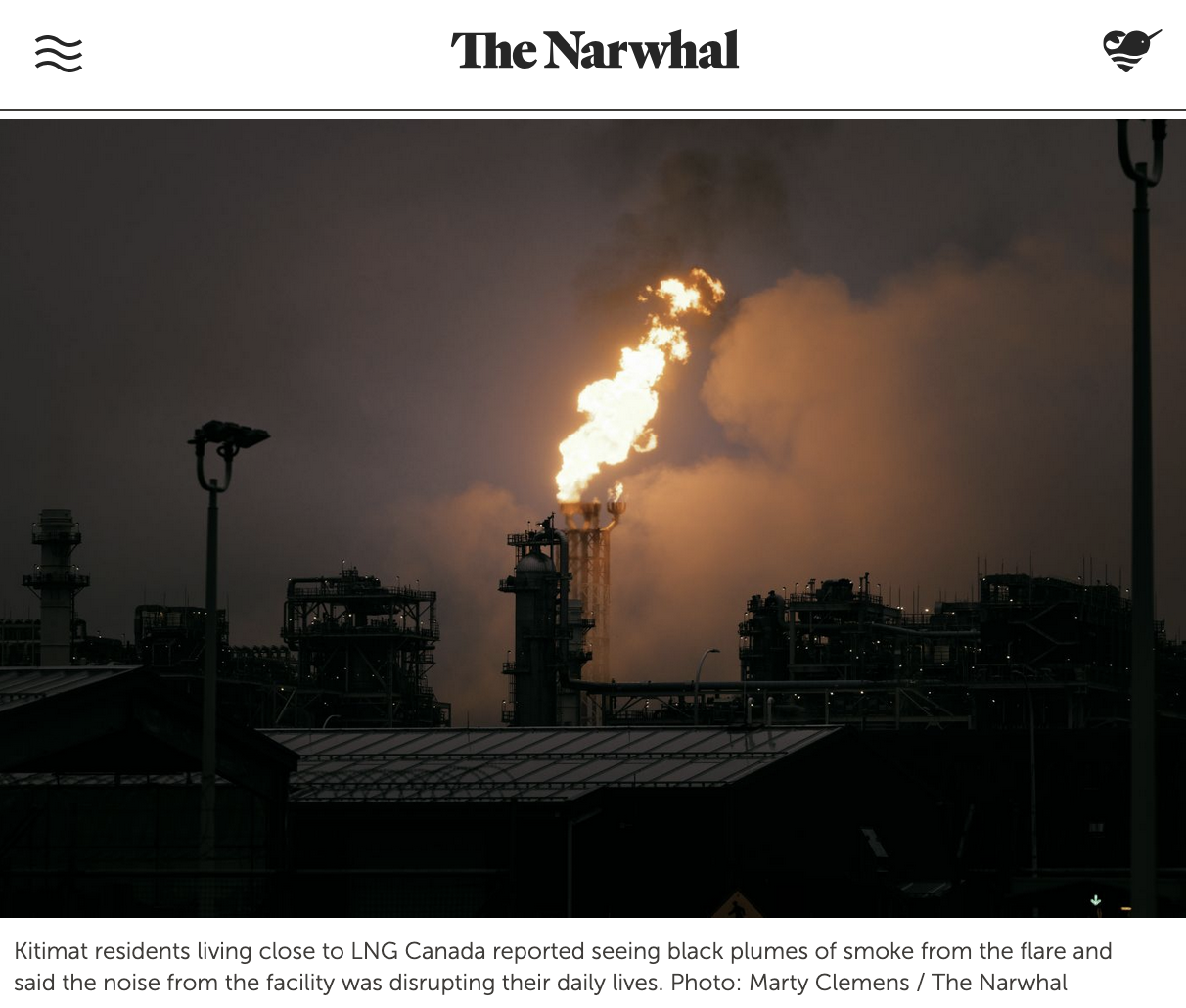
Government officials and project proponents try to frame LNG developments like LNG Canada Phase 2, Ksi Lisims and Cedar LNG as “lower-carbon” energy that can displace coal and support global climate goals. But these claims rely on a narrow accounting of emissions. Liquefaction represents only a fraction of LNG’s total climate impact; the majority occurs across extraction, processing, pipeline transport, shipping, regasification and ultimately combustion. At every stage, the leakage of methane – an especially potent greenhouse gas – significantly worsens the project’s true emissions footprint. A major study recently concluded that the lifecycle emissions of LNG can actually equal or exceed those of coal.
Crucially, the false premise that LNG acts as a “transition fuel” is increasingly at odds with climate science and market realities. Gas is a major and growing source of global emissions, and leading energy bodies like the International Energy Agency have made clear that limiting global heating to 1.5°C requires no new oil and gas expansion. Rather than displacing coal, new LNG infrastructure increasingly competes directly with renewable energy, delaying the transition to cleaner, cheaper alternatives.
Canada’s proposed LNG projects would also lock in emissions for decades. With long development timelines and operational lifespans of 30-40 years, new LNG facilities proposed today risk extending fossil fuel use well beyond mid-century – far past the timeline required to meet the goals of the Paris Agreement and the net-zero obligations of pension funds. Investing in new LNG projects is not just out of step with the climate – it’s a risky bet tying pension funds to high-emitting infrastructure that the world can no longer afford.

Indigenous right to consent at risk
Proponents and government officials have framed Ksi Lisims LNG, PRGT and Cedar LNG as Indigenous-led projects. However, these projects lack the free, prior and informed consent (FPIC) of impacted Indigenous communities, creating a risk of protracted legal challenges, delays and blockades, while deepening divisions within and between communities.
This risk is compounded by the federal approach embedded in the Building Canada Act. As noted by West Coast Environmental Law, the Act “shift[s] the focus of project reviews from whether they should proceed to how they should,” sidelining a core element of FPIC – the ability to meaningfully determine whether a project proceeds at all.
Investment policies that align with the United Nations Declaration on the Rights of Indigenous Peoples (UNDRIP), including FPIC, are critical to ensuring that pension funds respect Indigenous rights in practice. Among Canada’s largest public pension funds, clear, actionable UNDRIP-aligned commitments remain rare. By contrast, Swedish fund AP2 explicitly states that portfolio companies are expected to uphold “rights for Indigenous peoples and local communities, including the right to land and to free, prior and informed consent. AP2 has zero tolerance of threats and violence against human rights and environmental champions.”
In this context, investing in LNG projects that lack clear, demonstrable consent of all impacted First Nations and Indigenous communities exposes pension funds to legal, reputational, and material financial risks – making such investments incompatible with fiduciary obligations.
What does pension fund leadership look like in this context?
Pension funds being approached for investment in major projects must recognise that there are better investment opportunities than risky fossil fuel expansion projects. Our largest public pension funds can support Canada’s economy by investing in climate-aligned infrastructure such as renewable energy, public transit and electricity transmission, and in projects that have the consent of First Nations and align with the future that we want to leave for our children and grandchildren.
Pension funds should enter investment decisions armed with a checklist and only consider investing in projects that:
Have free, prior and informed consent from all impacted Indigenous communities;
Have meaningful alignment with Canada’s domestic and global climate obligations; and
Have long-term financial viability to meet funds’ fiduciary obligations to invest in the best interests of the contributors and beneficiaries whose retirement savings are at stake.
Your pension fund invests on your behalf and should not be gambling your retirement savings in a bet against the energy transition. Take action today: tell your pension manager to rule out investments in high-risk LNG projects that violate Indigenous rights and lock in climate failure.