CPPIB spotlights oil and gas expansion – again – as Canadians suffer through climate impacts
In late June, residents of Lytton were ordered to evacuate as an out-of-control wildfire burned south of the village in British Columbia. A week later, 600 residents of Kasabonika Lake First Nation were evacuated from the remote Oji-Cree community in northwestern Ontario. In Ottawa, one of the worst storm events in decades forced the cancellation of Canada Day celebrations and left thousands of Ottawa households with flooded basements and power outages. In Toronto, GO trains were cancelled and emergency departments were inundated by patients suffering through the extreme heat that gripped much of eastern Canada – a heatwave that Oxford University-based World Weather Attribution declared “would have been virtually impossible in a climate without fossil fuel use.”
As more and more Canadians are experiencing the worsening impacts of climate change first-hand, the Canada Pension Plan Investment Board (CPPIB) decided – once again – to showcase how it’s investing our national retirement fund in the primary cause of the climate crisis – fossil fuels. On June 23, CPPIB published Turning Volatility Into Opportunity: How Long-Term Capital Helped Teine Energy Scale – a spotlight on its investment in one of Canada’s largest private oil and gas producers, Teine Energy.
CPPIB’s spotlight on Teine Energy
Teine Energy is 90% owned by CPPIB and part of the pension fund’s dubiously-named “Sustainable Energies” portfolio. Two senior staff from CPPIB’s “Sustainable Energies” group sit on Teine’s board, providing direct oversight of the oil and gas producer.
The profile of Teine is the latest in CPPIB’s Mapping Canadian Capital series. Of a total of eight companies featured in the series, three have been fossil fuel firms, with previous features on oil and gas producer Canadian Natural Resources Ltd. last August and pipeline company Wolf Midstream last September. The series fits a well-documented pattern of CPPIB preferentially boosting the oil and gas sector, even as CPPIB executives call climate change “the single biggest source of risk for the fund.”
CPPIB’s investment in Teine is predicated on expanding and prolonging production
CPPIB boasts how its $1.3 billion multi-year investment in Teine enabled the company to grow its production from 1,000 barrels of oil equivalent per day (bpd) in 2011 to 45,000 bpd in 2025, by acquiring oil and gas producing lands and reserves and optimizing operational capacity. CPPIB highlights “the next chapter of Teine’s story” in Alberta and Saskatchewan: “a longer-cycle development opportunity with significant resource potential” and “a scalable source of production growth.” A May 2026 Corporate Presentation highlights how Teine is committed to “growing reserves.”
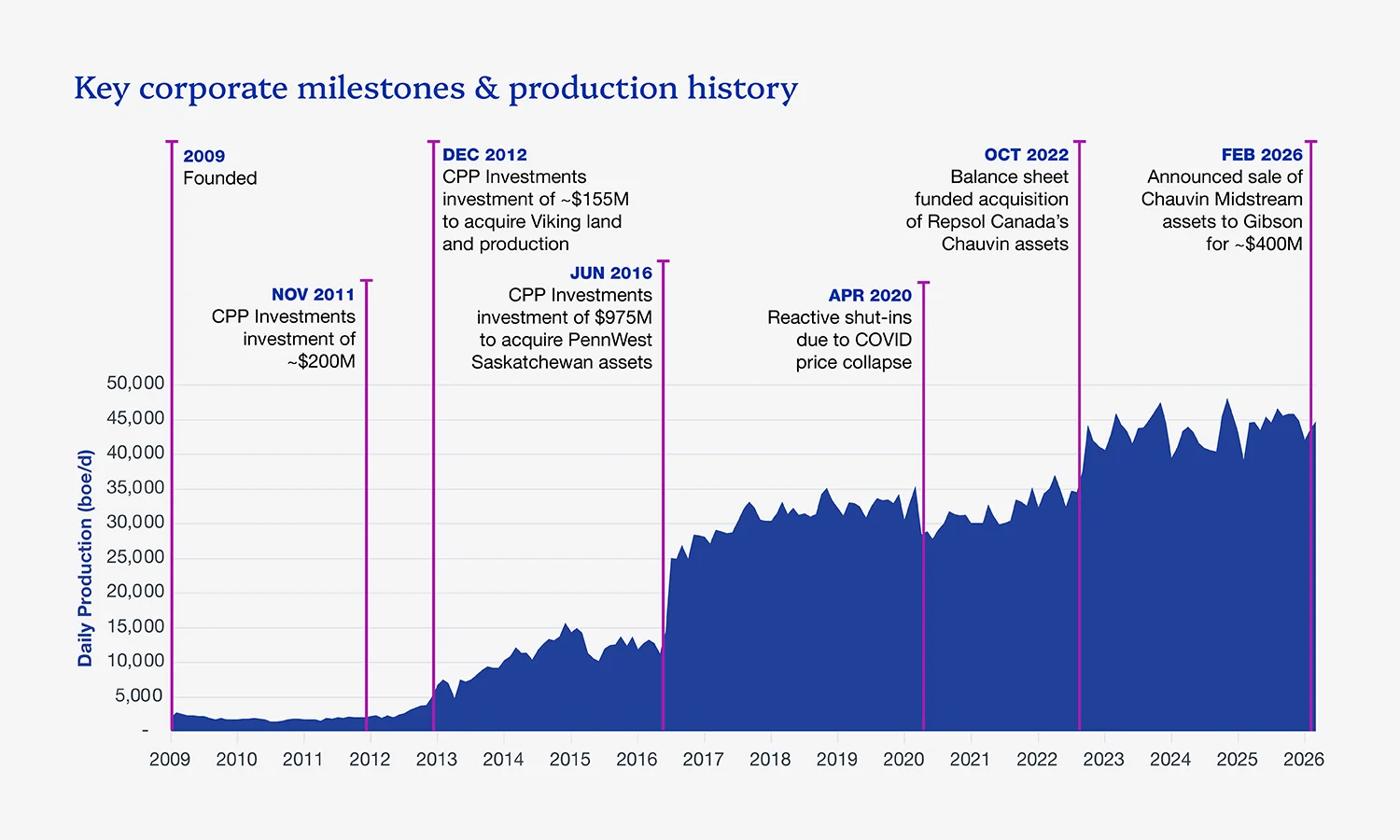
Photo credit: Teine Energy, CPP Investments Insights Institute
While climate action may have momentarily fallen out of favour with Canada’s political and business elites, CPPIB cannot ignore the uncompromising physics of the climate crisis. With every barrel of oil that is extracted, refined, transported and burned, the planet gets hotter, the impacts of climate change get worse, and the risks to the Canada Pension Plan (CPP) and Canadians’ retirement security intensify. With CPPIB’s Chief Sustainability Officer recently warning that the world is on a pathway toward 3°C of warming, it is baffling that CPPIB would choose to use the CPP to bring that hothouse world closer to reality – and then boast about it as a smart investment as their own members’ lives are upended by heat waves, wildfires and floods.
Unsubstantiated claims of reducing Teine’s carbon footprint
Last October, a webinar co-hosted by the Canadian Association of Physicians for the Environment, For Our Kids and the Canadian Lung Association showed unpermitted methane and other pollutants spewing from Teine Energy’s infrastructure in Saskatchewan (at 24:00). Tim Doty, an oil and gas expert and former air quality inspector at the Texas Commission on Environmental Quality, concluded that “this is not what you want to see” and that these emissions were harming the climate and human health.
When a concerned mother of two teens asked about Teine’s pollution at a public meeting in Calgary in February, a CPPIB executive said he was “more than happy” to bring her concerns to Teine. The Calgary mother has not heard back from CPPIB, nearly five months later.
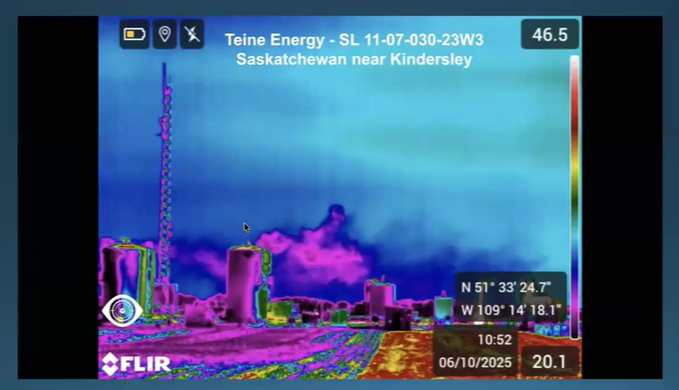
Optical Gas Imaging camera footage of a Teine Energy storage tank releasing methane and other unpermitted pollutants into the atmosphere (Source: Canadian Association of Physicians for the Environment. “Clean Air, Healthy Kids & Communities: The Case for Strong Methane Regulations,” at 24:00)
CPPIB’s spotlight claims that Teine’s “emissions are down nearly 50%” since 2019, a supposed example of how the company is “always thinking long-term”. CPPIB does not provide any evidence for this alleged reduction in Teine’s carbon footprint. Neither the company nor CPPIB publishes any ESG reports or climate disclosures to back up this claim. It is possible that CPPIB is referring to a reduction in emissions intensity. But with the graph in CPPIB’s spotlight showing that Teine’s production increased by about 50% since 2019, confusing a reduction in absolute emissions reductions and a reduction in emissions intensity could be misleading to Canadians.
Teine is publicly working to prevent the energy transition
Teine Energy’s climate-wrecking business model and plans to increase production are likely why the company’s CEO signed a joint letter last September from the oil and gas industry to Prime Minister Carney, demanding that the federal government dismantle climate policies and regulations, including repealing the Impact Assessment Act and West Coast tanker ban, eliminating the oil and gas emissions cap and ending the federal industrial carbon pricing regulation. Since then, the federal government capitulated to many of Teine’s demands, with the Prime Minister acknowledging that Canada’s greenhouse gas emissions will increase and our climate obligations won’t be met.
Teine’s clear opposition to the energy transition is in line with the Saskatchewan government, which said that “moving away from oil and gas… isn’t going to be happening anytime soon”. That’s likely why in 2024 the province tapped Teine to produce oil and gas courses for high school students. The courses consist of 50 hours of "online theory" and 50 hours of work placement and seem to prepare students for disappearing jobs in a dead-end industry.
Public reaction against putting Teine in charge of education for Saskatchewan high school students was swift: The Saskatoon Star Phoenix said “it now appears the province has sold a sliver of its education system to an oil company for propaganda purposes,” while the Regina Leader-Post asked “isn’t there at least a perception problem of corporate indoctrination of high school kids?"
Teine Energy’s business model is fundamentally incompatible with Canadians’ retirement security
Teine’s own Environmental Protection Policy claims that the company is “committed to conducting petroleum exploration, development and production operations in a manner which maximizes the potential of reserves.”
This directly contradicts CPPIB’s own “Climate Change Principles”, which commit our national pension manager to:
“Invest for a whole economy transition required by climate change,”
“Exert influence to create value and mitigate risk,” and
“Support a responsible transition.”
Increasing oil and gas production is fundamentally incompatible with these principles, and CPPIB’s board of directors should start asking the pension fund’s executives to explain this glaring contradiction – and why CPPIB executives feel that it’s so important to spotlight our national pension manager’s investment in this company.
Companies like Teine Energy are actively working against CPPIB’s ability to deliver on its long-term mandate and protect the retirement security of Canadians. This is exactly why young Canadians are taking CPPIB to court and alleging a failure to adequately manage climate-related financial risks.