Over the last month, the Canada Pension Plan Investment Board (CPPIB) held public meetings in eight cities across Canada (CPPIB public meetings were also held in Calgary and Edmonton in February). These meetings, which CPPIB is required by law to hold every two years, are a rare opportunity to engage directly with the staff and executives that manage the $864-billion Canada Pension Plan (CPP) on behalf of over 22 million contributors and beneficiaries.
The climate crisis, fueled by the burning of oil, gas and coal, poses an existential threat to our retirement security. CPPIB has a duty to invest in the best interests of all working and retired Canadians, young and old, and is mandated to maximize returns without undue risk of loss. Its investment and asset management decisions are critical to how Canada and the world navigate the global transition to a clean energy future.
That’s why so many Canadians showed up to these public meetings to demand accountability for how CPPIB is protecting our retirement security amidst a worsening climate crisis. Here are Shift’s key takeaways from the meetings:
Canadians’ concerns about CPPIB’s approach to climate risk, fossil fuel investments and Indigenous rights dominated the meetings
CPPIB continued to demonstrate a lack of transparency and accountability
CPPIB provided no meaningful updates towards development of an Indigenous rights policy
CPPIB acknowledges escalating climate risk – but won’t stop investing in fossil fuel expansion
Read on for the details.
Canadians used their mobile phones to capture photos, audio recordings and videos at seven of the CPPIB meetings (all but the one in St. John’s), which included questions from attendees and answers given by senior staff and executives at CPPIB staff. The audio recordings for meetings in Vancouver, BC (October 6th), Ottawa, ON (October 8th), Winnipeg, MB (October 14th), Saskatoon, SK (October 15th), Halifax, NS (October 19th), Charlottetown, PEI (October 26th), and Fredericton, NB (October 27th) can be found here.
After reviewing these recordings. Shift has provided the meeting location and timestamp of questions and comments from meeting attendees, and the response given by CPPIB staff and executives.
While the in-person public meetings wrapped up in Fredericton on October 27th, CPPIB is holding a national virtual meeting on November 19th. Submit your questions to the virtual meeting today!
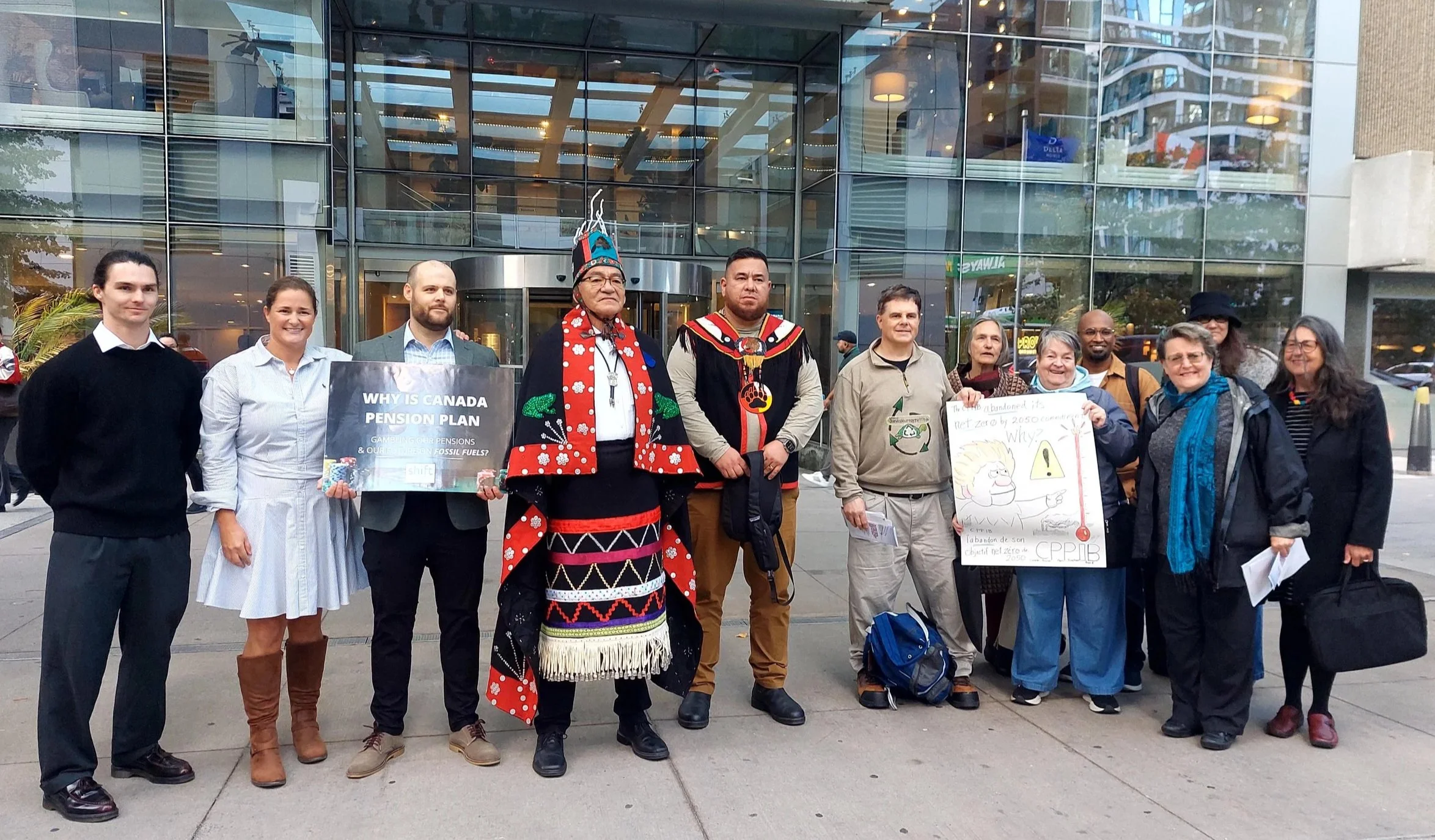
Photo: Indigenous leaders, climate-concerned Canadians and Shift staff outside the CPPIB’s public meeting in Ottawa on October 8th, 2026. Credit: Nathalie Hewa Dewage / Canada's National Observer.
1. Canadians’ concerns about CPPIB’s approach to climate risk, fossil fuel investments and Indigenous rights dominated the meetings
From coast to coast, Canadians showed up in droves to express their concerns about how CPPIB is managing our national pension fund. Shift estimates that nearly two-thirds of all questions asked related to climate change, fossil fuel investments and Indigenous rights.
Another 8,000 Canadians signed a petition calling on CPPIB to develop a credible climate plan, stop investing in fossil fuel expansion, and respect Indigenous rights by ensuring investments uphold free, prior and informed consent. Shift delivered the petition to CPPIB staff at the meeting in Ottawa on October 8th.
Local media outlets covered the meetings in Ottawa and St. John’s, while a Nova Scotia resident published her experience at the Halifax meeting in the Halifax Examiner (non-paywalled version here).
In Halifax, a young woman asked CPPIB executives to contemplate what the world will look like for their children and grandchildren if we don’t avert dangerous climate change (43:04). In Ottawa, a retired oncologist urged CPPIB executives to consider the deadly health impacts of fossil fuels (45:59). In Halifax, a Raging Grannie asked CPPIB executives if they understood the widespread suffering and economic chaos that could come if the world fails to achieve net-zero emissions by 2050 (19:24). In Saskatoon, a lawyer, farmer and engineer asked why CPPIB’s annual report suggests that the CPP would fare better in a dangerous global heating scenario than a safe net-zero scenario (3:38).
The climate crisis poses an existential risk to our national pension fund and our collective security, and Canadians made sure CPPIB couldn’t ignore this unsettling fact.

Photo: Climate-concerned Canadians attending the CPPIB public meeting in Winnipeg on October 14, 2026.
2. CPPIB continued to demonstrate a lack of transparency and accountability
It couldn’t have been easy for CPPIB staff to travel to eight different cities in three weeks and respond to tough questions from rooms full of passionate people. Shift recognizes the efforts of the dedicated staff who organized these meetings and responded to Canadians’ questions.
But many attendees reported that CPPIB staff did not meaningfully answer their questions or address their legitimate concerns – that CPPIB “stonewalled” them and treated the meetings like a “check-box” exercise that evaded real accountability. Many reported feeling that they were treated with dismissal and condescension by the CPPIB executives hosting the meetings.
In Charlottetown, the CPPIB host ignored a question from an attendee about the climate litigation launched by young Canadians against CPPIB (52:58), while saying in Vancouver that “lawsuits are part of the business” and “anybody can sue anybody” (53:56). In Halifax, this executive said that the final question of the evening, regarding the potential cost of legal liabilities for investments in companies complicit in war crimes and human rights violations, was “not a reasonable question” and walked off the stage (55:48).
In fact, at every meeting, the CPPIB executives hosting the Q&A promptly walked off the stage at 7:00pm, in some cases leaving long lines of attendees waiting at the microphones for their chance to ask questions. Some attendees complained that CPPIB hadn’t answered the questions they submitted two years ago when our national pension manager held its 2024 public meetings! When Shift delivered a petition signed by over 8,000 Canadians to a senior member of CPPIB’s staff in Ottawa, he refused to commit to responding to the concerns raised in the petition.
While bragging about its supposed world-leading transparency, CPPIB does not provide a livestream, audio, video or transcript from any city – even though these are public meetings advertised by a public pension fund taking place in public spaces hosted by a federal Crown corporation. At each meeting, CPPIB executives discouraged attendees from filming or recording the Q&A session, leading many participants to clarify that it was a public meeting and they wanted their questions to be recorded. In Halifax, the CPPIB executive hosting the meeting complained that an attendee was filming his answer to a question (22:24).
Luckily, the attendees across the country who took photos, videos and recordings have provided some semblance of transparency and accountability for the presentations and Q&A at these public meetings. Shift reiterates its call for CPPIB to provide meaningful responses to all questions asked in-person or submitted online, to livestream future public meetings, and to make transcripts and video and audio recordings publicly available so that all Canadians have an opportunity to participate.
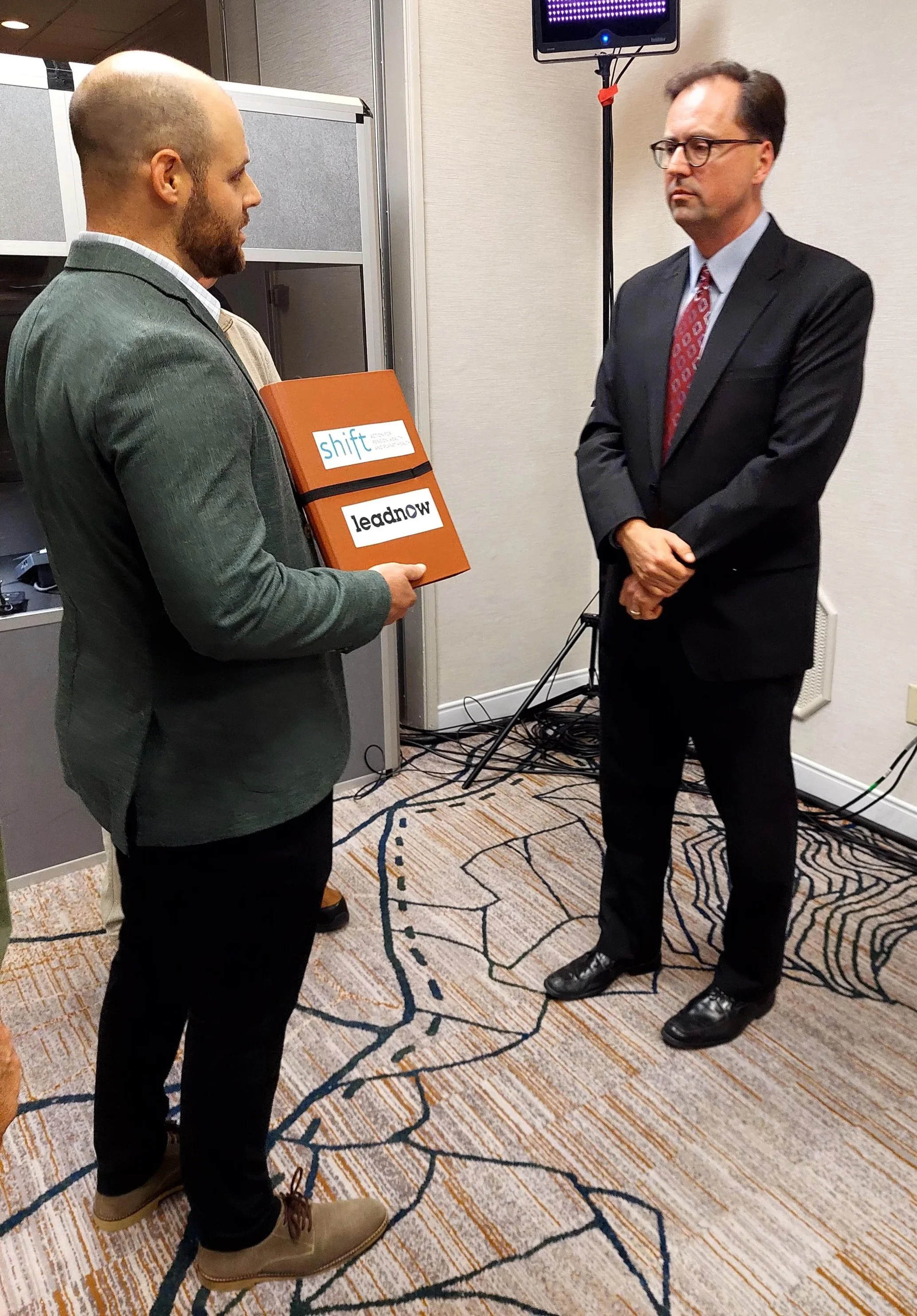
Photo: Shift’s Patrick DeRochie delivering a petition signed by over 8,000 Canadians to CPPIB Managing Director of Stakeholder Affairs Jeffrey Hodgson in Ottawa on October 8th, 2026.
3. CPPIB provided no meaningful updates towards development of an Indigenous rights policy
Two years ago at public meetings in Ottawa, Winnipeg and Vancouver, CPPIB staff and executives said they recognize First Nations as rights and title holders, are regularly engaging with Indigenous groups and stakeholders, and have formed an interdepartmental committee to study the implications of the United Nations Declaration on the Rights of Indigenous Peoples (UNDRIP).
As covered in Shift’s August 2026 report, none of Canada's large pension managers, including CPPIB, have publicly disclosed investment policies citing UNDRIP and its core principle of the right to free, prior and informed consent (FPIC).
At this year’s CPPIB public meetings in Vancouver and Ottawa, Indigenous leaders again questioned CPPIB executives and received the exact same boilerplate answers as they did two years ago. In Vancouver, Tsleil-Waututh nation and Tulalip tribe member Cedar George-Parker asked for a commitment to ongoing consultation between CPPIB and his nations (26:08). Wet’suwet’en Hereditary Chief Na’Moks (16:12), Gitxsan leader Gwii Lok'im Gibuu (24:35), and Pukatawagan Cree member Clayton Thomas-Müller (21:52) asked CPPIB not to invest in projects or companies that are planning to build or expand fossil gas pipelines and liquefied natural gas (LNG) terminals in their territories.
CPPIB refused to make any commitments to these Indigenous leaders. Their questions are all the more relevant since, in September, CPPIB announced a “Maple Fund” with private asset management giant Brookfield to “generate and execute up to C$50 billion in equity of large-scale investments in critical infrastructure and strategic industries across Canada.” The federal government is attempting to ram through legislation to fast-track such infrastructure projects. Indigenous leaders are already threatening and launching litigation to ensure that their constitutional rights are protected and the FPIC of impacted First Nations is attained before projects can be built.
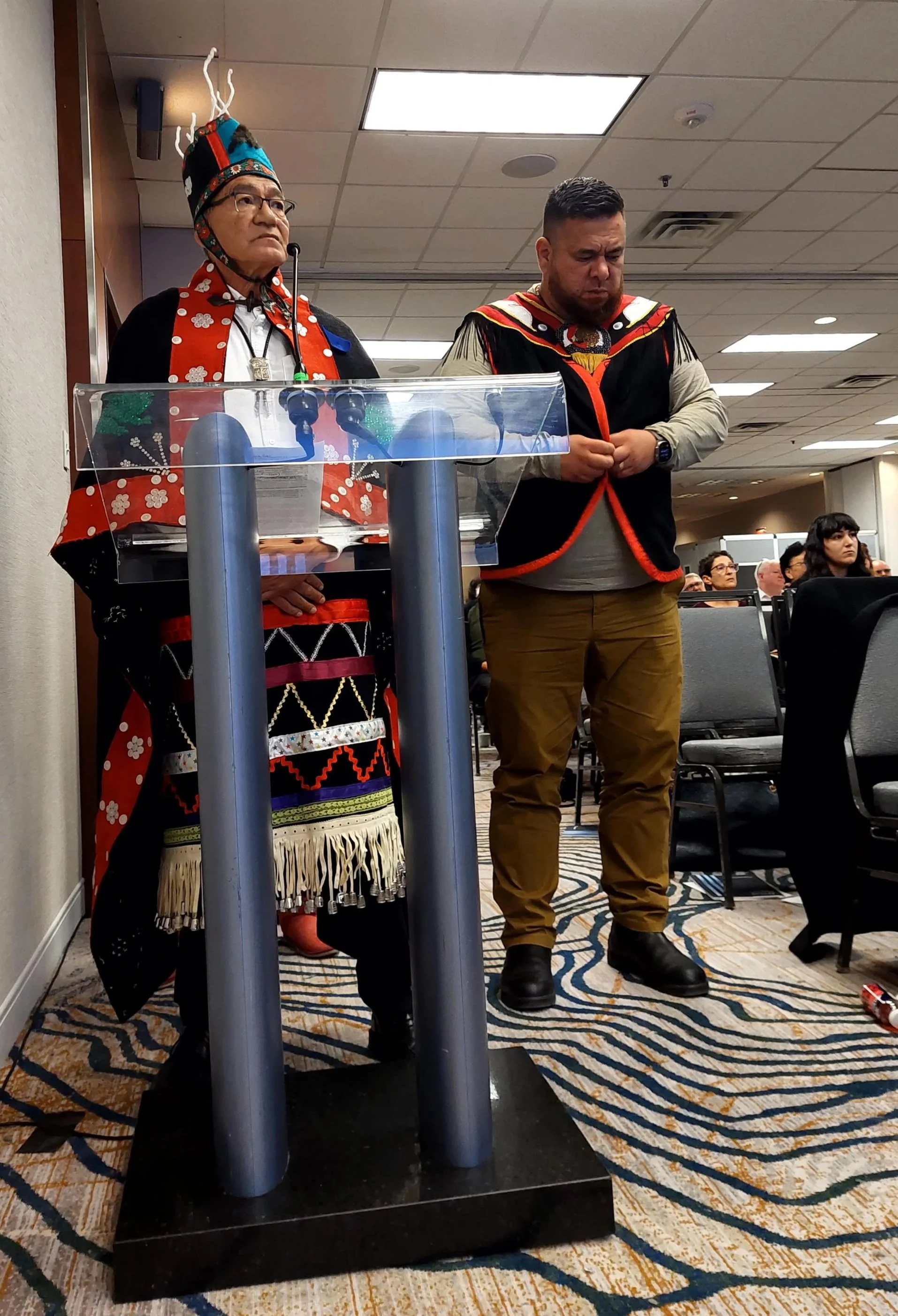
Photo: Wetsu’wet’en Hereditary Chief Na’Moks asking a question at the CPPIB meeting in Ottawa on October 8th while Gitxsan leader Gwii Lok'im Gibuu looks on.
4. CPPIB acknowledges escalating climate risk – but won’t stop investing in fossil fuel expansion
CPPIB says that it understands the alarming reality of the climate crisis – yet still invests in fossil fuel expansion and downplays the critical role that CPPIB, as one of the largest pension funds in the world, could play in the energy transition.
In Vancouver, a CPPIB executive conceded that “climate change clearly is one of the single biggest sources of risk for a long-term investor” (29:30). Across the country, in Halifax, Winnipeg, Saskatoon and Fredericton, CPPIB executives agreed that the science is real, the data is authoritative, and the trendlines and timelines are worrisome. In Halifax, the meeting’s host explained that “we have some teams that spend quite a bit of time assessing that data” (22:24), and highlighted the risk of stranded assets at meetings in Winnipeg (46:30), Halifax (23:55), Charlottetown (57:37) and Fredericton (28:00).
CPPIB’s executive leadership must not be listening to its own climate analysts, then, because the pension manager reported a significant increase in its fossil fuel holdings over the last two years. At public meetings in October 2024, CPPIB disclosed that 3.5% of the fund – or $22.6 billion as of March 31, 2024 – was invested in fossil fuels. This October, CPPIB provided an update, disclosing that 3.6% of the fund – $28.7 billion based on CPPIB’s AUM as of March 31, 2026) – was invested in fossil fuels, including oil, gas, coal, oilfield services companies and pipelines.
This represents an increase of over $6 billion in two years. Shift has documented how CPPIB made at least $6 billion in new fossil fuel investments in 2025 alone, is financing four new LNG terminals, and is investing in gas plants to power AI data centres. For comparison, CPPIB disclosed that its total holdings in renewable energy assets are just $13.1 billion – or 1.7% of the fund – a figure that an attendee at the Vancouver meeting called “super embarrassing" (52:16).
Even as CPPIB claims to acknowledge the authoritative science, severity and urgency of the climate crisis, it continues to invest our national pension fund in fossil fuel expansion – locking in additional oil and gas use, delaying the energy transition, crowding out renewable energy, making the climate crisis worse, and exacerbating risks to the CPP. Shift has documented years of CPPIB’s contradictory approach to climate change, for example in “CPPIB’s fundamentally flawed decarbonization thesis for fossil fuels” and “The High-Risk Climate Contradictions of the Canada Pension Plan.”
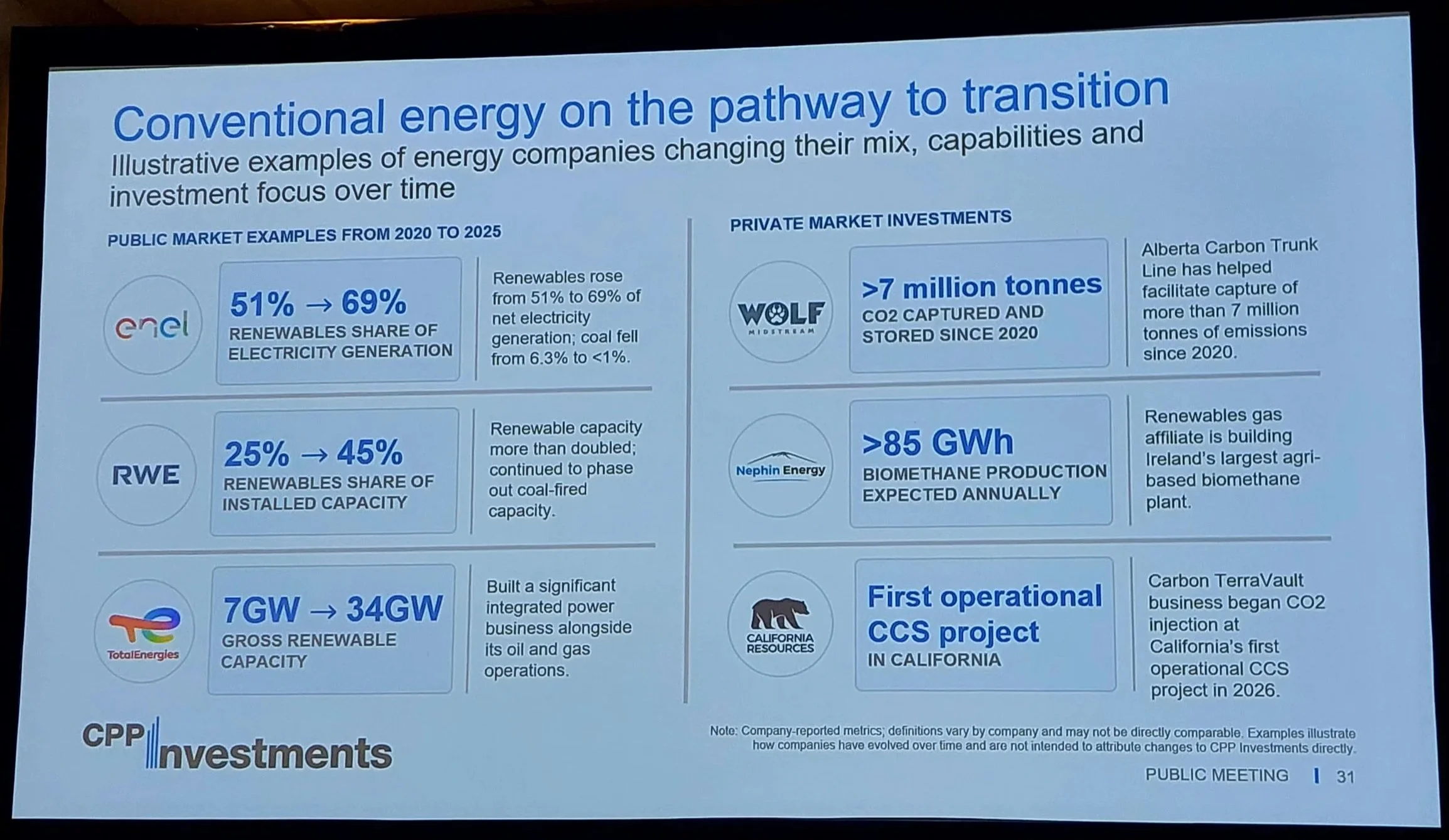
Photo: Slide displayed at CPPIB public meetings in Ottawa on October 8th and Fredericton on October 27th.
CPPIB continued to justify this confusing and contradictory approach to climate change and fossil fuels at this month’s public meetings. For example, in Ottawa and Fredericton, CPPIB displayed a misleading slide entitled “Conventional energy on the pathway to transition” that falsely implied that six fossil fuel companies are aligned with a climate safe energy transition. CPPIB executives claimed that CPPIB’s role in investing in and overseeing these companies is to ensure they “have an authentic transition plan” (Ottawa, at 28:55) - but the facts show otherwise.
For example, one of the companies on the slide, Wolf Midstream, is 99% owned by CPPB, with two senior CPPIB staff sitting on the company’s board. Less than a month before the Ottawa meeting, Wolf announced a final investment decision to proceed with the Phase 3 expansion of its NGL North pipeline system, which will increase the production of natural gas liquids (NGL) by 110,000 barrels per day (bpd), enable the construction of a 37-megawatt gas plant, and expand the transportation of NGL by rail by 60,000 bpd. The condensates transported by Wolf’s pipeline system is used to help more bitumen flow through oil pipelines and provide more feedstock for Alberta’s petrochemical industry. Wolf reported that the expansion was enabled by an incremental investment of approximately $500 million from CPPIB. This follows a $1 billion investment in Wolf by CPPIB in July 2024 that enabled the Phase 2 expansion of the NGL North System.
Any reasonable observer would see the absurdity in CPPIB’s claim that its investments and oversight of Wolf are enabling the company to “transition”. CPPIB is investing in long-lived infrastructure that expands and prolongs the production and use of fossil fuels. That’s literally the opposite of “energy transition”. That a CPPIB executive would tell Canadians otherwise either demonstrates dishonest greenwashing or a fundamental misunderstanding of what the energy transition entails.
Alarmingly, the CPPIB executive told attendees at the CPPIB public meeting in Winnipeg that “we're going to be having this conversation [about fossil fuel phase-out and energy transition] in 30 years from now, and we will not have moved” (45:26).
Stay tuned for a deeper analysis of CPPIB’s responses to questions about climate change, fossil fuels and the energy transition, based on dozens of responses provided by CPPIB executives during the public meetings across Canada.
Conclusion: CPPIB is failing to respond to Canadians’ concerns on climate and Indigenous rights
By law, CPPIB is required to hold public meetings in every province every two years, so it’s not often that Canadians have an opportunity to engage directly with executives overseeing our national pension fund. This month, Canadians showed up in droves to tell CPPIB that they are deeply concerned about CPPIB’s approach to climate risk, continued investment in fossil fuel expansion, and lack of an Indigenous rights policy.
Unfortunately, Canadians left these meetings feeling discouraged that CPPIB wasn’t meaningfully answering their questions and isn’t treating the climate crisis like the existential threat to our future that it is. There is no retirement security without a safe climate future to retire into. CPPIB’s mandate could become impossible to fulfill if we fail to avert the worst outcomes of climate change.
Canadians need national pension managers who understand this. Join our growing movement by submitting your questions about climate change, fossil fuels and Indigenous rights to CPPIB’s national virtual meeting on November 19th.